What is bidirectional charging and why is it such a relevant topic right now?
Niklas Hemberger:
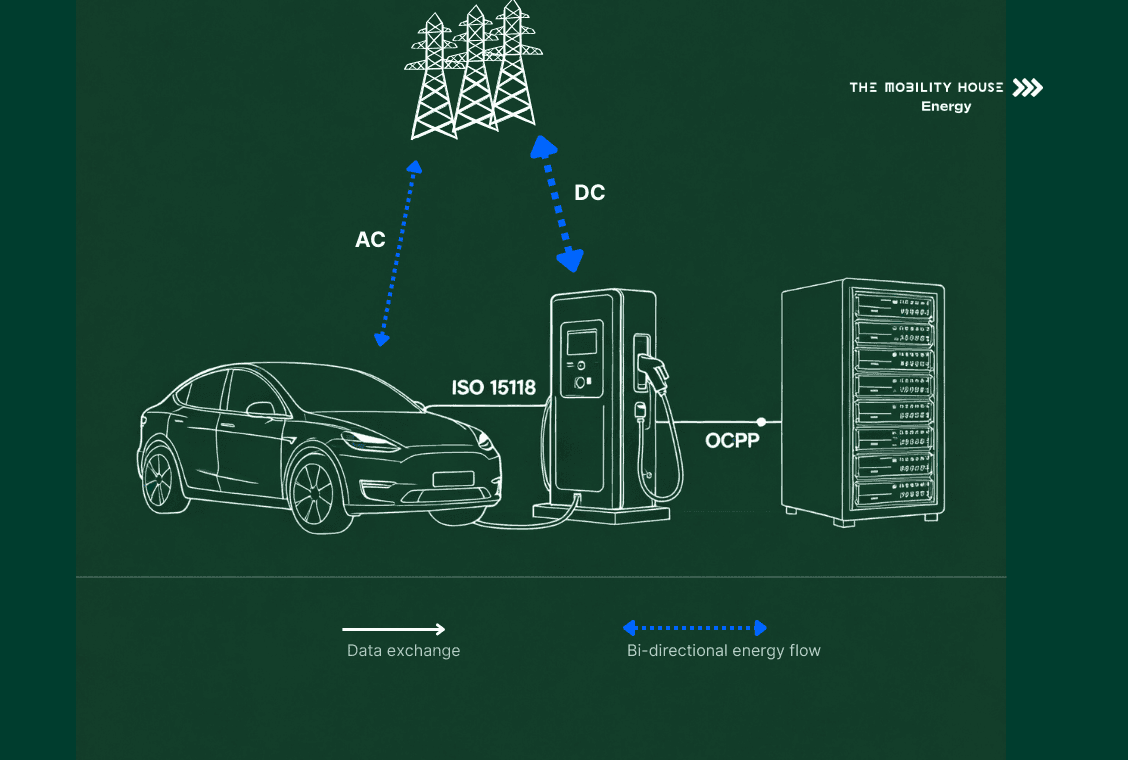
Bidirectional charging means that electric cars not only draw power from the grid, but can also feed energy back into the grid – into the home, the public grid, or the company premises. This is particularly important now because more and more renewable energies are having to be integrated into the grid, and their production fluctuates. Electric cars can serve as flexible storage devices and reduce grid and energy costs by balancing these fluctuations. However, for this technology to work, all individual components must communicate securely with each other.
What role do communication standards such as ISO 15118-20 and OCPP play in bidirectional charging?
Stefan Morscher:
The 15118-20* standard regulates secure communication between the car and the charging station. Part -20 is the latest standard in the field, while the previous version has a 2 at the end. This previous version mainly supports plug and charge; version 15118-20 builds on this, but requires a higher level of security and also enables the exchange of information for decentralized control, for example, regarding mobility requirements between the charging station and the vehicle.
Then there is the language between the backend and the charging station—this is where OCPP is important. OCPP regulates the control of the charging station through central infrastructure. While version 1.6 represents the established market standard, version 2.1 additionally enables communication for the integration of the charging station into the energy system. It can also integrate the charging station as an intermediary between the energy supplier and the car (and its user).
Niklas Hemberger:
Here's an example of what it might look like when the user plugs in the vehicle:
- The first step is to initiate authentication. The car reports: “Hello, I am a V2G-enabled car and I would like to authenticate myself here.”
- The charging station responds: “Okay, what can you do? I can charge AC, charge DC, and if you want, Bidi**.”
- It authenticates itself and establishes a secure connection.
- The Mobility House Energy approves the charging process via a secure connection to the charging station.
- Then, important framework data about the vehicle and battery is exchanged between the vehicle and our backend: “I want to leave tomorrow morning at 8:00 a.m. and need 20 kWh for that. In the meantime, I am able to feed up to 30 kWh into the grid.”
- In the next step, charging begins, controlled by a schedule that we determine based on the electricity market and continuously adjust to the market situation during the charging process.
- The charging process ends when the target charge level and departure time are reached. The Mobility House Energy creates a partial invoice for the charging and discharging process. In most cases, the kWh charged and the planned duration of the charging process are taken into account as indicators of the flexibility provided.
*International standard for communication between electric vehicles and charging infrastructure. It translates between the car and the charging station, so to speak, to ensure that energy and data flow securely. **Bidirectional
What do we need for smart charging?
Niklas Hemberger:
As backend operators, the first step is to find out from the vehicle what charging capacity and battery size it has and what time slots are available for charging and discharging. This is precisely the information that is transmitted via the message chain. This means that users first specify in the app or on the car display: “I'm leaving again tomorrow at 7:00 a.m. and want the vehicle to be 80% charged by then. I also want you to charge the car directly to 30%.” We call this the minimum state of charge, so that you can always drive to the nearest hospital if necessary.
Stefan Morscher:
In addition to user requirements, we as developers of The Mobility House Energy also need the vehicle status. For older cars, this is only available via the manufacturer's backends. Newer cars, on the other hand, support 15118 communication with the charging station and can thus provide battery parameters independently of cell phone reception (e.g., in underground garages).
When we receive the information from the vehicle via the charging station using OCPP, we can determine an optimal charging schedule on the energy markets.
This is the chain that runs for smart charging. Afterwards, the whole thing goes back again, of course.
How far have we come with our goal of interoperability between different car and charging station manufacturers?
Xi Zhang (EcoG):
The foundations for interoperability are in place and enable, among other things, the now announced market launch of a bidirectional wallbox, which we are producing together with you at The Mobility House, Mercedes, and EVtech.
The challenge with this wallbox solution lies in simultaneously supporting standard and proprietary solutions. Since proprietary systems are already established on the market, we as an operating system provider consider it our responsibility to bridge the gap here: by integrating the relevant services into the software, we are enabling a seamless transition to the standard solution.
For the standard solution, we have published and implemented guidelines for implementing the ISO15118-20 Bidi standard in collaboration with partners, including those in the automotive industry, as part of CharIN.
Stefan Morscher:
It is important to recognize that interoperability (enabled by 15118-20 communication) is still a matter of will. There is no longer any question of “how,” but each vehicle can use mutual authentication to help decide which charging station it wants to communicate with. This means that a certain willingness is required both from users, who must approve this in the car when they first plug in, and from vehicle manufacturers, who must also support the manufacturer of the charging station. Every car can respond with “I can't” when plugged in. This brings us back to the current world, where we charge via DIN or have simple standards that do not enable V2G. The key point is that every party involved must be willing and participate. The technical possibility alone is not enough.
This also represents the core disadvantage of alternative communication via vehicle backends: here, the user is completely dependent on the manufacturer and its willingness to make the necessary information available to third parties (e.g., The Mobility House Energy as an energy supplier) via its backend.
Implementation challenges: Is it solely up to the OEM to decide, or is it a question of how well the standards have been implemented?
Stefan Morscher:
To a certain extent, it's both. On the one hand, the standard must be implemented correctly for it to work, and this requires interoperability tests that manufacturers must actively carry out – as part of so-called testivals. At the second level, however, it remains an authentication at a technical level of two certificate trees. This means that both sides must specify which counterparties they accept when establishing a connection. Charging stations (or their manufacturers) must therefore be approved by the OEM, and vice versa.
During authentication, certificates are exchanged so that the charging station recognizes the car as a Mercedes-Benz, for example, and says, “Yes, I am allowed to communicate with this Mercedes-Benz.” The vehicle's certificate is technically traceable back to an original certificate from the manufacturer – and its signature must be stored on the charging station. The same applies to the charging station's certificate, whose original certificate must be known to the vehicle as trustworthy. This exchange can take place either during manufacture or during operation via our backend using OCPP.
These certificates are basically like a front door key and an ID card combined. They can be used for authentication and authorization and also have a very clear path to traceability. This means that it is possible to clearly trace which authority issued the ID card, which country this authority belongs to, etc. The TLS standard is used (for 15118-20 in the latest version 1.3), which is also the standard in Internet communication.
Automobile and wallbox manufacturers often claim to be “bidi-ready.” But are they really?
Niklas Hemberger:
Many LinkedIn posts by car or charging station manufacturers often portray it as if the charging station alone can enable vehicle-to-grid – which is not true. The real intelligence behind V2G lies with The Mobility House Energy as an aggregator that bundles the flexibility of many electric cars and makes optimal use of them on the energy market. Successful V2G requires a wealth of information, such as how many charging cycles the car is allowed to complete per year or how many kilowatt hours it can feed in so that the battery does not age prematurely.
Such limitations are set by the vehicle and must be taken into account in the aggregator's trading algorithms. This is much more complex than it sounds in public discussions. Charging stations themselves are hardly able to handle price or tariff information — only in the context of smart charging with fixed or dynamic tariffs can basic optimization work without central optimization by the energy supplier.
Stefan Morscher:
For example, a smart charging station with a time-of-use tariff can control charging at night rather than during the expensive evening peak. In the area of smart charging, this can reduce electricity costs to a certain extent – but it does not even come close to exploiting the potential of the car from the user's or the grid's point of view. With V2G, however, this “intelligence” is not enough: here, it depends on the aggregator in the background, which has to coordinate many parameters and conditions. This is exactly what The Mobility House Energy offers.
In V2G, the charging station's main task is to transfer energy and exchange data with the vehicle and backend in a secure communication. All truly crucial market and flexibility decisions are made by the central V2G platform or the aggregator. This allows vehicle restrictions, market prices, and grid status to be intelligently considered together, which the charging station alone would not be capable of.
In short, the charging station is necessary, but not the key to V2G—the real heart of the system is the platform that controls everything.
So what does “bidi ready” really mean from a technical point of view?
Xi Zhang (Eco-G):
From a technical point of view, the marketing term “bidi ready” usually just means that the hardware is physically capable of charging and discharging. However, several intermediate steps are still necessary to actually use the bidirectional functionality.
A functioning solution requires interoperable communication with the vehicles, which necessitates extensive testing with different models. In addition, third-party applications are needed to intelligently control charging and discharging. This is the only way to ensure that users' mobility needs are met while they benefit from the financial advantages of bidi functionality.
Stefan Morscher:
Exactly, ‘Bidi ready’ usually means that charging stations have implemented the 15118-20 standard, which includes bidirectional charging and ensures communication, nothing more. It's just a matter of technical compatibility, which is often theoretical at first. Manufacturers mean that when V2G becomes available in vehicles, they will provide customers with a software update. Essentially, the hardware is receptive to over-the-air updates and has a crypto processor that supports TLS 1.3.
Due to the lack of vehicle availability on the market, charging stations are not (yet) typically tested for interoperability – so whether bidirectional charging will actually be possible with a future vehicle remains uncertain for users.
AC vs DC: What are the technical differences in the backend?
Stefan Morscher:
With AC charging, the conversion of electricity from alternating current to direct current takes place directly in the vehicle, which is why most grid code regulations specifically apply to the car and not just the charging station. In this context, the AC charging station is technically little more than a smart socket – no different from the familiar unidirectional charging. In terms of hardware, bidirectionality in the flow of electricity entails only minimal additional requirements; the metering concept is more crucial, because when feeding back into the grid, the electricity must be measured accurately in both directions.
Niklas Hemberger:
The electricity at the so-called transfer point, i.e., where the vehicle is connected to the grid, is always relevant for billing. Grid code certification is also particularly important in the AC sector: here, the entire system consisting of the car and charging station must be tested together in order for a feed-in permit to be granted in accordance with German standards such as VDE-AR-N 4105. The charging station alone is not sufficient for this, because the crucial power electronics (the inverter) are located in the car.
In contrast, with DC charging, the inverter is located in the charging station, which is why only the device itself needs to be certified and can be used independently of the connected vehicle. In the area of AC bidirectionality, it is currently stipulated that only manufacturer-specific combinations of charging station and vehicle are permitted. This standard will probably remain in place until at least 2027, before the long-term goal of arbitrary combinability of bidi charging stations and vehicles is pursued.
In short: With AC bidirectional charging, the car and charging station are one system – there are no individual cross-manufacturer solutions (yet). DC bidirectionality can be ensured by the charging station alone; the vehicle only needs to master and support the necessary communication standards..
Vehicle-to-grid in “everyday car life”: And once again, it falls asleep...
Stefan Morscher:
Vehicle-to-Grid (V2G) is often presented as a way for cars to simply feed energy back into the grid. In practice, however, this only works to a very limited extent. V2G requires feed-back only a few hours a year, but the constant availability of the vehicle is crucial. To do this, the car must remain connected and be reliably wakeable when needed. Today, however, vehicles are designed for an average of only 2–3 hours of operation per day—outside of this operating time, control units and the charging control unit go into sleep mode. This interrupts the communication that is essential for V2G.
Currently, many cars can charge bidirectionally, but they cannot provide energy for long periods of time while “asleep” and at the same time available (out of sleep). Permanently maintaining the charging or discharging power to prevent sleep behavior would be technically possible and would enable the household to be supplied in the event of a blackout, but it would not make economic sense. In daily operation, the vehicle would be subjected to very high stress due to up to a factor of 10 higher operating hours. Standby power consumption (200-400W in common vehicles) also corresponds to approximately the average nighttime consumption of a household and is therefore very expensive for the user in the long term. The power loss of the vehicle thus significantly increases the total power consumption of the household. This is precisely why ISO 15118-20 plays a central role: it contains explicit pause and wake-up commands that enable sleep states but can still wake up a vehicle at any time to access the battery. Renault is already implementing this in accordance with the standard.
For the solution to work, car manufacturers must integrate the ISO 20 functions into the overall architecture of their vehicles. The goal is a mode of operation that uses as few active control units as possible and reduces internal consumption. This is a matter of both efficiency from the user's perspective and the durability of the control units, which are not yet designed for continuous operation.
Ultimately, V2G is not just a question of charging capacity, but requires changes to the entire electronic architecture of the vehicles.
Outlook for bidirectional standards
When do you think bidirectional charging will become established in everyday life?
Xi Zhang:
From our point of view, bidirectional charging will have arrived when this technology has been seamlessly integrated into the everyday lives of both private and commercial customers. The key to this is open architecture: At EcoG, we enable the seamless integration of third-party services so that real business models can emerge. In this way, we hope to contribute as a market accelerator to making bidi a reality soon.
Maximum reliability and interaction between our software and electric vehicles are also important. We want to create a solid foundation that makes bidirectional charging suitable for the mass market. To this end, we have created a special index, the EcoG Charging Reliability Index, which makes it possible to test how well vehicles already communicate with charging stations.
Stefan Morscher:
Mercedes-Benz and BMW will each launch vehicles with V2G capabilities in early to mid-2026. With a certain delay in getting started, we clearly see 2027 as the year of V2G in the German market as well. With a lot of luck, V2G could arrive here as early as 2026, at least in its initial stages, but it will definitely become more relevant in 2027.
Niklas Hemberger:
We are already on the market in France with Renault. It's working great, and we will also go to Germany with the manufacturer, and eventually to the UK. However, we at The Mobility House Energy do not want to limit ourselves to Germany because there are other hurdles here, such as billing standards and different network operators.
Other countries are much further ahead and have a simpler approach. However, the fact that we have imprecise communication standards is not an obstacle. The standards are now in place with 15118-20, and we can also work well with OCPP 2.1. These standards now just need to be adopted across the board. The OEMs are already getting moving. That makes us feel positive.
Definition of terms ISO 15118 and OCPP
ISO 15118
ISO 15118, specifically version ISO 15118-20, defines digital communication between electric cars and charging stations for bidirectional charging, i.e., for vehicle-to-grid (V2G) and vehicle-to-home (V2H). It regulates authentication and the secure exchange of energy and control data.
ISO 15118-20 enables vehicles to accept and correctly execute system commands such as discharging.
OCPP (Open Charge Point Protocol)
OCPP (from version 2.0 and especially 2.1) is the standard for communication between charging stations and backend systems (e.g., operators, network operators). OCPP 2.0/2.1 supports ISO 15118 functions such as Plug & Charge and bidirectional charging. It also enables advanced energy management and integration into the smart grid.