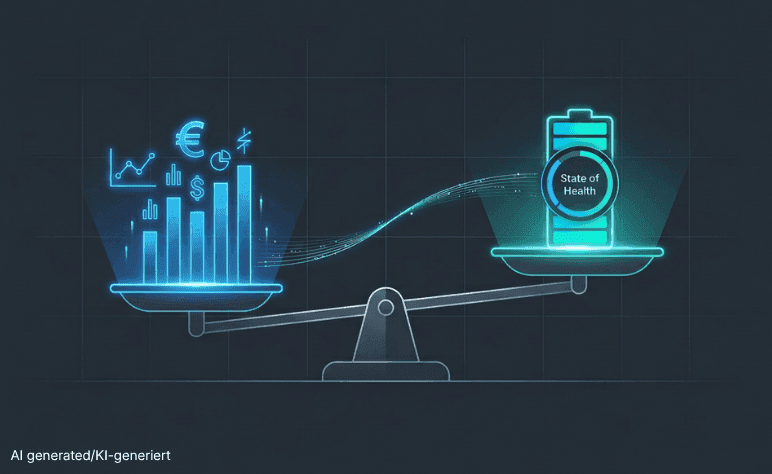
Revenue versus lifetime is the defining trade-off in the commercialization of battery energy storage systems (BESS). Every cycle a storage asset performs generates revenue — but it also contributes to battery degradation. In other words, every cycle comes at a cost. Investors should therefore proactively factor in degradation to avoid leaving potential returns on the table.
For The Mobility House Energy, degradation management is a core discipline of battery optimization. Rather than maximizing short-term revenues at the expense of battery health, our algorithms incorporate the opportunity cost of degradation into every dispatch and trading decision.
In this article, we explain how this enables us to maximize the lifecycle return of your battery asset.
Understanding Battery Degradation in BESS
Battery degradation is driven by two main forces, starting with calendar aging. From the exact moment a battery cell is manufactured, spontaneous chemical reactions cause it to age. This process runs faster the more 'stressed' the battery’s electrochemical state is.
Second, active use directly impacts performance: every charge-discharge cycle slightly chips away at the battery's ability to store and release power. This is what we call cyclic degradation.
The more cycles (a complete charge and discharge) a battery goes through, the faster it wears down. This deterioration accelerates under certain conditions, such as high charging speeds, deep discharging, or extreme temperatures during operation.
Both calendar and cyclic degradation increase internal resistance. This causes round-trip efficiency to fall and power losses to rise, which in turn generates extra heat during operation. Concurrently, the battery’s usable capacity is permanently reduced.
What Role Does Degradation Play in BESS Commercialization?
Degradation directly affects the economics of a battery asset. As storage capacity and efficiency decline, the commercial life of the battery shortens, reducing the period over which revenues can be generated. At the same time, less energy can be sold into spot markets, and effective participation time in grid balancing services decreases.
This makes degradation a central factor in every commercialization decision. Across different revenue streams, there is a structural trade-off: high short-term revenues often come with higher degradation.
For example:
- Spot markets (intraday and day-ahead) can offer attractive price spreads, but often require deep cycling that accelerates degradation.
- Frequency Containment Reserve (FCR) is comparatively gentle on the battery, as it typically involves fewer cycles and operates within a low-degradation state-of-charge window of around 30% to 65%.
- Automatic Frequency Restoration Reserve (aFRR), by contrast, generally requires higher charge/discharge currents and deeper discharge than FCR, which can lead to increased degradation.
The key question in BESS optimization is therefore: Does an additional dispatch make economic sense if the projected revenue is lower than the degradation cost it causes?
This question can only be answered if the marginal cost of degradation (the additional cost of one more cycle) is known.
This is precisely where the value of an experienced optimizer lies: in an intelligent multi-market approach. The objective is not to maximize individual market opportunities in isolation, but to continuously balance revenue and degradation in real time based on the current battery condition, and strategically with a view to future market developments.
BESS Operation: How to Minimize Degradation While Maximizing Revenue
Battery degradation cannot be prevented. But a strong BESS optimizer can manage it economically and maximize lifecycle returns despite it.
At The Mobility House Energy, we address calendar aging through intelligent state-of-charge management. In practice, this means keeping cells out of high state-of-charge ranges for as little time as possible, since these accelerate aging.
We integrate cyclic degradation directly into our optimization logic. To do this, we rely on high-resolution condition data from the battery management system and a precise understanding of the system’s current state.
Our optimization algorithms incorporate real-time data on temperature, state of charge, cycle count, and cell imbalance in the form of marginal degradation costs. A dispatch is executed only if the expected market opportunity exceeds the associated degradation cost.
To avoid accelerated degradation, we seek to limit harmful operating conditions and processes, in particular:
- high C-rates (charge and discharge rates)
- deep discharge and overcharging
- operation at extreme temperatures
- prolonged operation at very high or very low state of charge
These operating modes are only justified if the incremental revenues more than offset the degradation costs they create.
State of Health: The Key KPI for Tracking BESS Degradation
The most important metric in BESS degradation management is the State of Health (SoH). This indicator measures the current capacity of a storage asset relative to its original capacity.
A brand-new battery has a State of Health of 100%. Once it reaches a SoH of 60% to 80% (depending on manufacturer and cell chemistry) it is generally considered to have reached end of life.
Across the industry, this metric underpins decisions on maintenance, financing, and asset valuation. From a business case perspective, SoH has strategic importance: every percentage point of SoH loss corresponds to a quantifiable loss in future revenue potential.
Any BESS optimizer that fails to continuously monitor and forecast SoH is effectively operating blind. After all, determining the marginal cost of degradation is only possible if both current and projected SoH are known with absolute precision.
To establish a robust baseline, we conduct a capacity test before commercialization begins in order to calibrate SoH, and we recommend repeating this test regularly. At the latest, another test should be performed at the end of our optimization mandate so that realized revenues can be assessed against the asset value loss caused by degradation.
Why Standard BESS Systems Do Not Solve the Degradation Problem
Battery Management Systems (BMS) and Energy Management Systems (EMS) provide essential data and control functions for battery assets. However, they are not sufficient for active degradation management.
The BMS monitors cell voltage, temperature, and state of charge, and protects the system from overcharging, deep discharge, and overheating. It also supports more even aging across cells through balancing. In practice, however, BMS platforms generally retain only limited historical data (around one month) and rely on comparatively simple models. Over time, key state estimates become less accurate, and the picture of the system becomes increasingly distorted. This limits the ability to actively optimize degradation.
The EMS, meanwhile, executes the optimizer’s dispatch instructions and allocates them across the available systems. But it is typically not designed around market logic. It generally has no awareness of market prices or future dispatch schedules and therefore cannot, for example, “pre-cool” the system strategically or schedule cell balancing during low-price periods.
In other words, neither system creates a true link between battery condition, degradation cost, and market opportunity — the very alignment required for optimal, degradation-aware dispatch decisions.
From Black Box to Digital Twin: Degradation Management at The Mobility House Energy
Transparency into the true condition of a battery asset is the prerequisite for effective degradation management. As an optimizer, we need to understand not only the overall state of the system, but also how individual cells and modules evolve over time. This requires high-resolution condition data with historical depth rather than the snapshots, typically provided by standard systems.
That is why we build an individual battery model for every asset and rely on advanced battery analytics, including cloud-based models and digital twins. This allows us to continuously track the system’s current condition and the degradation cost of the next cycle during live operation.
We complement this approach with our proprietary local controller, which captures high-resolution data directly at the asset level. It enables us to monitor both the behavior of the battery and that of the EMS in use and to intervene where necessary. At the level of individual modules and units, we can optimize load distribution and selectively relieve critical components.
Based on these insights, we can implement asset-specific operating rules that minimize degradation without leaving revenue opportunities unused.
Furthermore, through intelligent operation, we can extend the BESS lifecycle, enabling us to generate revenue for asset owners for an additional one to two years in many cases. This gives us the flexibility either to monetize a particularly attractive market phase through more aggressive trading or, alternatively, to preserve cycle life and extend battery lifetime.

BESS whitepaper available for download
How are BESS revenue streams changing? And how can intelligent cycling strategies help protect the long-term value of a battery asset? Find out more in our free whitepaper.
Conclusion: Degradation Determines the Economic Success of a BESS Asset
At first glance, degradation may look like a maintenance issue. In reality, it sits at the core of the business case. Understanding and managing degradation is a strategic necessity. If it is not actively accounted for, revenues are overstated and costs understated.
Successful BESS commercialization therefore means evaluating every cycle not only by its short-term market value, but by its impact on the total value of the asset. That is the difference between short-term optimization and sustainable value creation.
A degradation-aware dispatch approach reconciles these two perspectives. It creates the right balance between revenues today and available lifetime tomorrow. Implemented properly, it enables:
- a longer economically productive life for the asset
- higher total revenues over the lifecycle
- lower risk, particularly with regard to warranty conditions
- and a more robust, more predictable business case trajectory
We account for degradation from day one. When assets enter operation under our optimization, we begin capturing the relevant data immediately, enabling forward-looking business case planning and helping unlock the asset’s full economic potential.
Because the economic success of a battery storage asset is not decided in individual trading periods but across its entire lifecycle.