What is energy trading?
Energy trading means actively buying and selling electricity, gas, or emission certificates – similar to how stocks or commodities are traded on stock exchanges. The aim is to ensure security of supply and environmental compatibility, manage price risks, and achieve economic advantages through clever strategies. The European market is increasingly focusing on renewable energies and green certificates, which makes energy trading particularly dynamic.
How does energy trading work?
Energy trading works through the exchange of energy contracts in a wide variety of time frames, from long-term supply contracts to short-term trading on the spot market. Electricity is usually traded in so-called bidding zones. Trading participants submit bids for purchase and sale, and the price is determined by market mechanisms based on supply and demand. Producers, consumers, and intermediaries control their activities in order to achieve optimal economic results.
Europe's trading venues and mechanisms for energy:
- Spot market (examples include EPEX, European Power Exchange, or Nordpool): Here, electricity is traded “just-in-time,” either only until the next day (day-ahead) or up to 5 minutes before delivery (intraday). This allows traders to respond flexibly to short-term fluctuations in weather, consumption, or supply.
- Futures market (e.g., EEX in Leipzig): Longer delivery periods for electricity or gas are traded—from 1 week to several years into the future, often as so-called futures. Here, companies secure prices for the future in order to reduce risks.
- OTC trading: Many transactions are also concluded directly between traders and suppliers (over-the-counter, OTC), such as regional electricity transactions or customized contracts.
- PPAs, Power Purchase Agreements: Long-term, individually negotiated electricity supply contracts between electricity producers (such as wind or solar plant operators) and electricity consumers.
Pricing is transparent and based on supply and demand – influenced by generation costs, CO₂ costs, weather, political requirements, grid conditions, and international markets.
What is the best way to trade energy?
Efficient energy trading requires the use of market signals and participation in different trading segments: long-term hedging on the futures market and short-term trading on the spot market. It is important to favor technology-neutral and market-based solutions that avoid distortions and promote the integration of renewable energies and storage technologies. Intelligent, high-frequency systems and market data help traders to dynamically adapt their strategies.
How we trade energy
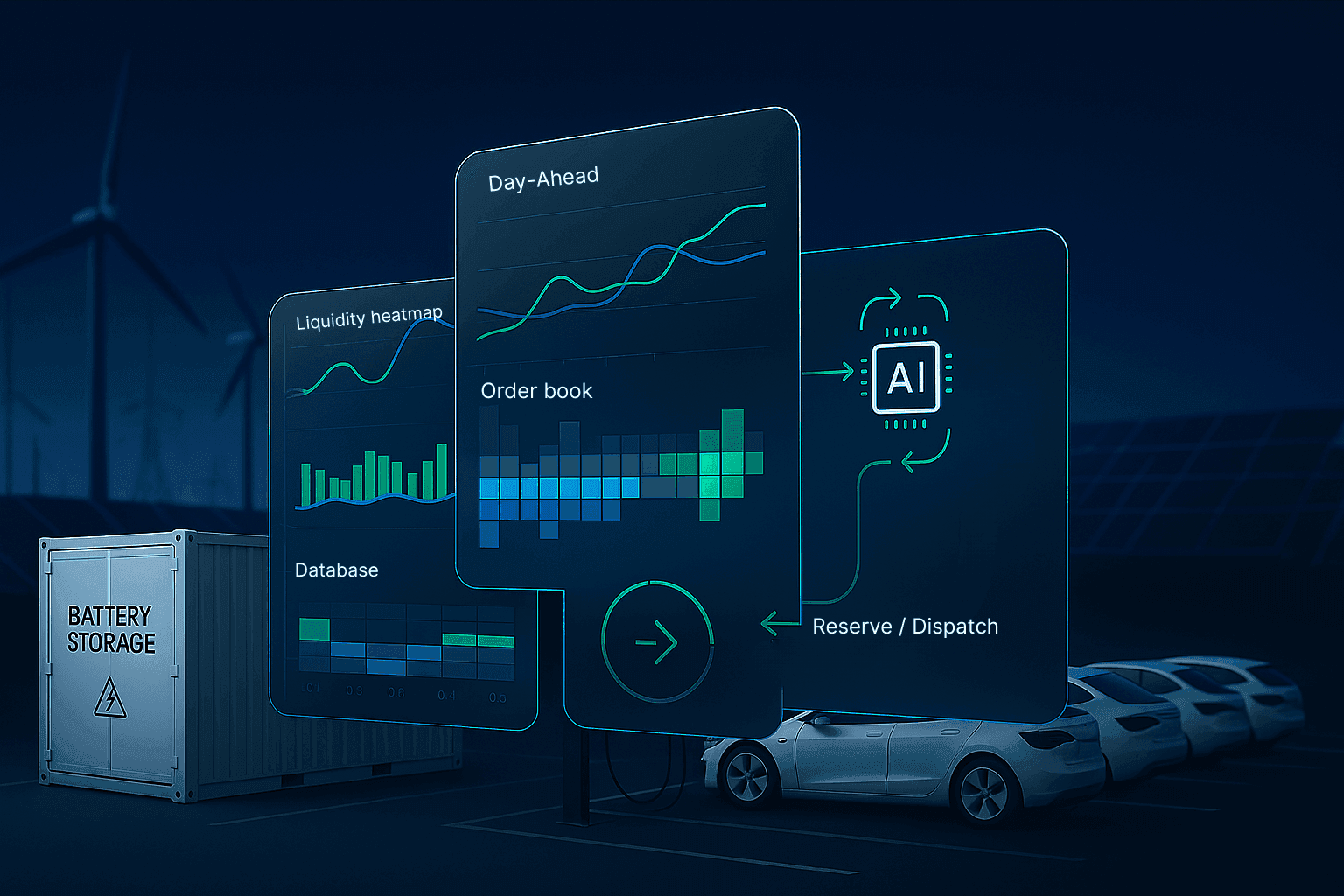
Our FlexibilityTrader operates internationally (including in Germany, France, and the Netherlands) and is directly connected to the EPEX Spot market (wholesale energy market) and various transmission system operators (TSOs) for the provision of ancillary services. It places bids in the order book* according to individual and predefined strategies. In intraday trading, execution and thus actual trading takes place within milliseconds and up to 5 minutes before delivery (closing time). This enables an immediate response to market dynamics. In day-ahead trading, on the other hand, electricity demand and feed-in for the next day are first analyzed before we set buy and sell bids. EPEX Spot then performs matching on an hourly basis.
The final market plan is then transferred to FlexibilityAggregator for disaggregation and physical fulfillment: the individual vehicles receive their charging power.
*In addition to all active buy and sell orders, an order book contains all limit orders on a trading venue, i.e., orders with upper or lower price limits.
8 important technical terms from European energy trading
Spot market |
The exchange for short-term trading in electricity, with delivery usually within 24 hours. This contrasts with the long-term futures market |
Futures market |
Trading venue for electricity deliveries at fixed prices in the future (e.g., months, years). Prices are set in advance, which ensures long-term planning for energy suppliers and protects them from sharp price fluctuations. |
OTC Trading |
“Over-the-counter”: Direct, off-exchange transactions between market participants. Marketing is carried out through these bilateral agreements, which offer a high degree of flexibility. |
Intraday trading |
Electricity trading within the same day, often to balance out fluctuations in the short term. |
|
A combination of distributed generation plants and storage facilities, controlled like a power plant. We use the FlexibilityAggregator platform to bundle these resources |
|
Merit order |
Ranking in which power plants are sorted according to their electricity production costs for market use. |
Balancing group |
Billing and balancing area in the electricity market, usually managed by a utility. |
Control energy |
Electricity reserve for stabilizing the grid in the event of fluctuating feed-in and demand. |