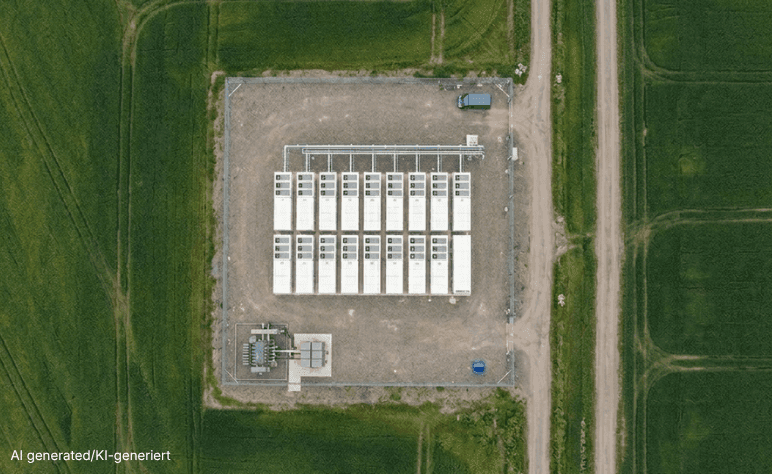
The key question in the commercialization of battery energy storage systems (BESS) is no longer whether they can be marketed, but how to do so economically, reliably, and at scale. And this is precisely where single-asset approaches start to break down: they run into structural limits.
The Limits of Single-Asset Marketing for Battery Storage
Individual monitoring, control logic, reporting: marketing each BESS on its own means that operational effort grows with every additional asset. Manual processes that are still manageable for a single system cannot be scaled across multiple assets without increasing staffing requirements.
In addition, when individual assets are dispatched independently, potential remains untapped: each battery is optimized in isolation rather than in coordination with other assets. As a result, neither optimal market allocation nor an efficient distribution of risks, utilization, and technical load can be achieved. At the same time, fixed costs such as prequalification, balancing group management, or IT infrastructure cannot be shared efficiently.
This becomes particularly problematic in (ancillary) energy markets with minimum bid sizes: smaller individual assets often fail to meet the required thresholds.
A single storage system is also subject to significant concentration risk. In the event of a technical failure, marketing revenues are lost immediately and in full, as there is no diversification across other assets. Moreover, market price risks directly impact profitability without the buffer of a portfolio.
The result is a linear growth model: more assets mean more effort, more costs, and greater complexity—but not necessarily greater economic efficiency.
None of this can be solved through better optimization at the individual asset level. It requires a different approach.
Why a Portfolio Delivers More Than Many Individual Assets
The portfolio approach transforms battery marketing. Instead of controlling and marketing individual battery storage systems in isolation, multiple physically separate assets are aggregated into a single, centrally controlled unit.
This bundling creates scale: many small assets become a relevant capacity that can overcome market entry thresholds.
At the same time, diversification increases. Different locations, technical configurations, and operating states reduce dependence on individual assets. Risks are not eliminated, but they are significantly mitigated at the portfolio level. As a result, the storage business model becomes more robust, flexible, and scalable.
Our growing portfolio as a flexibility marketer demonstrates that aggregation is more than theory; it’s a proven way to scale. So far this month, we added another 36 MW / 72 MWh.
But how do many physically separate assets actually become a single controllable unit? The answer lies in the aggregation logic itself.
How Multiple Storage Systems Become a Marketable Portfolio
Aggregation is often equated with simply bundling volume. But in reality, it fundamentally changes the control logic: a continuous control loop links asset status and market decisions in real time.
At its core, aggregation means that multiple BESS are brought together under a shared control logic: centralized control and joint optimization. Decisions are made faster and more efficiently because they are no longer taken at the level of individual assets, but centrally for the entire portfolio. Toward markets and grid operators, the portfolio appears as a single, unified actor.
How Does Aggregation Work?
The process consists of three sequential steps:
- Capture flexibility: For each asset, the actually available flexibility is continuously measured: current state of charge, available power, time windows, and technical constraints. Not as a static capacity figure, but as a continuously updated flexibility profile that forms the basis for all further decisions.
- Decide and aggregate: Based on the individual data, the algorithm determines the specific dispatch decision for each asset: which market, what capacity, and which time window. The results of these asset-level optimizations are then aggregated into a unified portfolio flexibility. In this way, many decentralized decisions are combined into a single market offering, which is traded via the aggregator’s balancing groups.
- Disaggregate and execute: The portfolio-level result is then distributed back to the individual storage systems. In practice, this means generating specific dispatch schedules for each asset, taking into account site-specific requirements, grid constraints, and technical limits. This step—disaggregation—closes the control loop.
If the state of an asset changes (due to an outage, power fluctuations, or changing grid conditions), the control loop runs through all three steps again.
The Marketing Advantages of an Aggregated Portfolio
An aggregated portfolio is marketed differentl, not because it has more capacity, but because it can address multiple markets simultaneously and in a coordinated way. It continuously allocates its capacity to the markets that offer the highest value at any given moment.
While individual assets are often limited to specific applications, a portfolio can operate in several markets in parallel:
- FCR: Portfolio size and redundancy help reliably meet requirements for availability and response speed.
- aFRR and mFRR: A portfolio can fulfill delivery obligations more robustly, even if individual assets are temporarily constrained.
- Spot markets such as day-ahead and intraday: Here, a portfolio can respond more quickly to price signals, shift capacity, and market larger volumes more efficiently.
This creates a key advantage for asset owners: the storage system is not tied to a single commercialization pathway but can become part of a dynamic multi-market strategy.
Greater Revenue Potential, Better Distributed Risks
The economic core of portfolio-based marketing lies in maximizing revenues not at the level of individual assets, but across the system as a whole. This creates room for so-called revenue stacking—the coordinated use of multiple markets and revenue streams.
At the same time, dependence on individual risks is reduced:
- Price risks can be mitigated because the portfolio is not reliant on a single market. Declining revenues in one segment can be offset by others.
- Technical risks become less significant. The failure of a single battery storage system no longer results in a total loss of capacity but only reduces the overall performance of the portfolio.
- Revenue risks are cushioned by the overall performance of the portfolio, leading to more stable and predictable income.
- Regulatory changes also have less impact. Since a portfolio is typically marketed across multiple market segments, dependence on individual regulatory frameworks or political decisions is reduced.
- Degradation risks can ultimately be balanced out by adding new assets to the portfolio. This decouples the lifecycle of the overall system from that of individual assets.
For asset owners, this means potentially more stable and predictable revenues combined with more robust operations. A transparent and fair allocation logic is essential to ensure that the added value of portfolio optimization is clearly reflected at the level of individual assets.
An often underestimated advantage of portfolio marketing lies in operational market execution: the portfolio approach enables transactions between individual assets to be netted internally before they reach the market. This internal netting reduces external transaction costs and increases operational efficiency. By bundling many individual orders into a single aggregated transaction, limited trading capacity at marketplace interfaces is used optimally. Instead of a large number of small trades, exchange communication is significantly reduced.
Why a Portfolio Becomes Stronger with Every New BESS
The real advantage of aggregation becomes apparent as the portfolio grows. While in single-asset marketing effort and costs increase proportionally with the number of assets, a portfolio increasingly benefits from economies of scale.
These include:
- Declining marginal costs: Fixed costs for platforms, IT infrastructure, algorithms, and regulatory processes are spread across a growing number of assets.
- Automation as a key scaling lever: As the portfolio expands, control becomes fully algorithmic. Decisions are data-driven and made in real time—regardless of whether there are ten or one hundred assets in the portfolio.
- Network effects: Each additional BESS increases the available data base. This data improves forecasting models for prices, availability, and demand. Better forecasts lead to more precise dispatch and, ultimately, higher revenues.
- Regulatory learning effects: Experience gained in existing markets is documented and can be transferred to new regulatory environments. This shortens onboarding times and lowers barriers to market entry.
With every additional BESS, asset owners benefit not only from greater marketable capacity, but also from improved efficiency of the overall model.
Portfolio-Based Marketing is a Competitive Advantage
Flexibility aggregation is more than a technical operating model. It bundles individual battery storage systems into a high-performing portfolio that can operate across multiple markets simultaneously and steadily increase its value over time. Instead of reacting to isolated price signals, the portfolio can shift flexibly between markets and capture opportunities as they arise. Risks are spread more broadly, revenue streams are stabilized, and the utilization of individual assets is increased.

BESS whitepaper available for download
How are BESS revenue streams changing? And how can intelligent cycling strategies help protect the long-term value of a battery asset? Find out more in our free whitepaper.