In just a few years, Bulgaria has become one of Europe's most attractive markets for Battery Energy Storage Systems (BESS). This market overview explores what's driving Bulgaria's BESS boom, which revenue models are emerging, and what challenges investors and developers should keep in mind.
Bulgaria's Power Market: The Basics
For decades, Bulgaria's power system was dominated by coal and nuclear energy. When the country joined the EU in 2007, it kicked off a gradual liberalisation of the electricity market, along with the introduction of the first support schemes for renewable energy. This sparked a subsidy-driven boom in solar and wind power in the early 2010s which was later brought to an abrupt halt by cuts to feed-in tariffs.
It wasn't until the EU's climate targets, the European Green Deal, and in particular Bulgaria's National Energy and Climate Plan (NECP) that the country's energy transition regained momentum.
According to Aurora Energy Research, Bulgaria has already met its 2025 renewable energy target: renewables now account for around 35% of installed capacity. By 2030, renewable capacity is expected to nearly double, driven mainly by rapid growth in solar installations. Over the same period, the country's electricity demand is expected to rise to around 50 TWh.
Status Quo: Where Does Bulgaria's Battery Storage Market Stand Today?
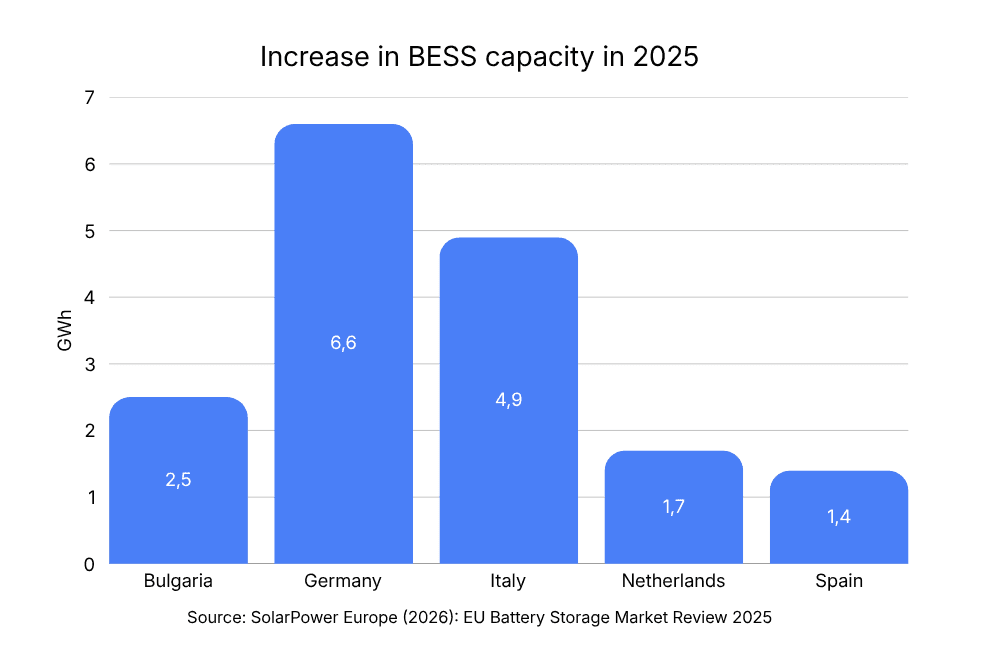
BESS had their breakthrough moment in Bulgaria in 2025. According to SolarPower Europe's annual EU Battery Storage Market Review, the country ranked third in the EU for newly installed battery storage capacity: with roughly 2.5 GWh added, Bulgaria trailed only Germany (6.6 GWh) and Italy (4.9 GWh). That represents a year-on-year increase of more than 1,100% compared to 2024 (around 200 MWh) making Bulgaria the fastest-growing BESS market in Europe.
The country is also among the frontrunners when it comes to co-located projects: according to Aurora's 2026 European Co-location Market Report, Bulgaria ranks within the top 3 countries in Europe for market attractiveness, based on project economics, market size and outlook, and development environment.
Bulgaria's NECP originally set a battery storage target of just 1.28 GW by 2030. Yet according to Aurora Energy Research, more than 14 GWh of storage capacity has already been awarded through auctions.
The scale of this build-out becomes even clearer when you weigh Bulgaria's current installed BESS capacity of over 4 GW against the country's actual electricity demand: depending on the time of year and time of day, Bulgaria's load curve ranges from around 4 GW to a maximum of roughly 7 GW.
The picture looks just as striking on the generation side: Bulgaria tops the global ranking for battery storage as a share of total power system capacity, at 16%, ahead of California in second place, at 14%. As a result, battery storage now covers more than 46% of the country's combined solar and wind capacity.
Bulgaria's BESS Market at a Glance (as of July 2026):
- Installed capacity: ~4.5 GW
- Capacity added in 2025: 2.5 GWh (+1,100% vs. 2024)
- Share of total power system: 16%
- Pipeline: 14 GWh awarded through auctions
Why Is Battery Storage Booming in Bulgaria?
The storage boom is rooted in Bulgaria's massive solar build-out: according to the country's transmission system operator, Bulgaria now has more than 6 gigawatts of installed PV capacity, equivalent to 32.7% of the country's total installed generation capacity. The result has been persistent periods of zero and negative prices around midday during the summer months. This price signal creates a direct incentive to store solar power and sell it later, at a more favourable time.
Beyond this underlying market potential, it was above all state support that allowed Bulgaria's BESS market to scale so quickly. Under Bulgaria's Recovery and Resilience Plan (RRP), the first funding was awarded to co-located battery storage in 2024. Across the first two auction rounds, Bulgaria awarded approximately 1.18 GW of battery storage capacity alongside 3.1 GW of solar generation. Because these projects were required to reach commissioning by March 2026, this created substantial short-term demand for storage systems and accelerated the roll-out of co-located projects.
The RESTORE programme followed with tenders dedicated to standalone battery storage. Funding covered up to 50% of investment costs. Across two rounds, this supported a combined total of roughly 14 GWh of standalone storage capacity.

BESS whitepaper available for download
How are BESS revenue streams changing? And how can intelligent cycling strategies help protect the long-term value of a battery asset? Find out more in our free whitepaper.
Revenue Streams: Where Does a Bulgarian BESS Make Money?
Unlike other European markets, where ancillary services have historically dominated BESS revenues, profitability in Bulgaria is driven primarily by wholesale price volatility.
Day-Ahead and Intraday Arbitrage (Wholesale Arbitrage)
Trading optimisation on the spot market is the main driver of storage revenues in Bulgaria. The massive build-out of solar PV has so far regularly produced extreme low-price periods around midday and high prices during the evening peak. However, the rapid growth of BESS capacity itself is increasingly working against this very pattern: as more and more battery systems charge and discharge within that same window, midday prices are starting to rise, while the evening peak is being increasingly capped. As a result, daily max-min spreads in the market can already be seen narrowing.
A further factor shaping how price spreads will develop going forward is Bulgaria's growing interconnection with neighbouring markets. Greece is increasingly emerging as the region's solar powerhouse, with midday surpluses similar to Bulgaria's — leading to close price coupling between the two markets during the day. Romania, on the other hand, tends to push evening peak prices upward. While these markets are linked via cross-border transmission capacity (interconnectors), that capacity is increasingly insufficient to fully align prices: during the day, Romania and Bulgaria are typically coupled, while in the evening their prices increasingly diverge.
For Bulgarian storage operators, this means the evening peak isn't only being capped by domestic BESS build-out, it's also shaped by imported price signals from Romania. This effect can partly offset the narrowing of spreads that would otherwise be expected when looking at the Bulgarian market in isolation.
Ancillary Services
So far, battery storage systems in Bulgaria only have access to the manual Frequency Restoration Reserve (mFRR) market. FCR and aFRR markets exist in Bulgaria, but batteries are not yet eligible to participate in them.
Closer integration with the European balancing platforms PICASSO and MARI could open up access to primary and secondary reserve markets for battery storage in the future.
Co-Location Advantages
According to Aurora Energy Research, Bulgaria delivers one of the highest internal rates of return (IRR) in Europe for co-located projects (solar PV + BESS) commissioning in the coming years.
Sharing grid infrastructure between the solar plant and the battery reduces capital expenditure (CAPEX). The storage system also protects solar revenues from market cannibalisation (the price collapse caused by high solar feed-in around midday) by storing that power and shifting it to the more profitable evening hours.
Bulgaria's BESS Revenue Streams at a Glance (as of July 2026):
|
Revenue stream |
Market access for BESS |
|---|---|
Primary Reserve (FCR) |
no (access planned) |
Secondary Reserve (aFRR) |
no (access planned) |
Tertiary Reserve (mFRR) |
yes |
Day-Ahead Arbitrage |
yes |
Intraday Arbitrage |
yes |
Curtailment Capture |
yes (in co-location) |
Capacity Market |
no (market not yet in place) |
Revenue Stacking |
yes (limited) |
What Challenges Does Bulgaria's BESS Market Face?
Despite Bulgaria's impressive growth figures, a closer look reveals several challenges as well:
The 75/25 Subsidy Rule
For subsidised co-located assets, at least 75% of stored energy must come from the co-located solar plant, with a maximum of 25% allowed to be charged from the grid. This significantly limits usable charging strategies, particularly when solar power is more expensive than cheap off-peak grid electricity at night.
Grid Constraints
At co-located sites with multiple users sharing the same point of interconnection, grid operators prevent simultaneous charging and discharging. Many assets are also designed for injection only, which reduces the value actually captured compared to the theoretical model.
Regulatory Immaturity in Ancillary Services
Batteries currently only have access to the mFRR market, not to aFRR or FCR, and no capacity market exists yet. Without these markets opening up, the business case remains essentially limited to intraday and imbalance arbitrage.
Lagging Wind Power
Wind power has stagnated in Bulgaria for a long time. In the medium term, this holds back the additional demand for flexibility that would otherwise benefit storage.
Outlook: How Will Bulgaria's BESS Market Develop Going Forward?
BESS growth is set to remain strong in the near term: capacity is expected to grow four- to fivefold in 2026.
Several developments will be key to the future quality of revenues:
- Opening of ancillary service markets: Whether and when Bulgaria will open access to aFRR and FCR remains unclear, according to Solarplaza. Without this opening, revenue diversification will remain limited.
- PICASSO/MARI cross-border coupling: The balancing interconnection between Romania, Hungary and Bulgaria, expected in 2027, is likely to intensify regional competition for ancillary services, while potentially opening up new market access at the same time.
- A possible easing of the 75/25 subsidy rule for co-located projects, which currently limits charging flexibility.
- Catching up on wind power: New wind projects could bring the first meaningful additional capacity over the next few years.
Conclusion: Bulgaria's BESS Market Offers High Potential, But Demands Expertise
In a remarkably short space of time, Bulgaria has become one of Europe's leading battery storage markets. Yet the market remains demanding: illiquidity, regional price dependencies on neighbouring countries, and limited access to ancillary service markets such as FCR and aFRR are real hurdles. Those who navigate these challenges with confidence, however, stand to gain a decisive edge in one of Europe's most dynamic storage markets.
This is where The Mobility House Energy comes in: as an experienced battery storage marketer with extensive project experience in Bulgaria, we bring exactly what this market requires. Our risk management tools factor Bulgaria's illiquidity directly into the optimization process. We're in close dialogue with the transmission system operator and stand ready for the moment FCR or aFRR opens up to battery storage — backed by our multi-market approach. Thanks to our local presence and holistic optimization, we're also ideally positioned to serve neighbouring markets across Southeast Europe.