Renewable sources are contributing an ever larger share of electricity generation. While this is a highly positive development, it also creates a familiar challenge: surplus generation around midday and elevated demand in the evening. At the same time, millions of electric vehicles remain idle for most of the day—often plugged in, with battery capacity available.
A more useful question for advancing the energy transition, then, is not whether enough renewable electricity can be generated, but how that electricity can be used when it is needed most. This is where virtual power plants built around electric vehicles can play a pivotal role.
What Is a Virtual Power Plant?
At first glance, the term virtual power plant may sound futuristic, perhaps even suggestive of robotics or artificial intelligence. In practice, however, virtual power plants have been in operation for years.
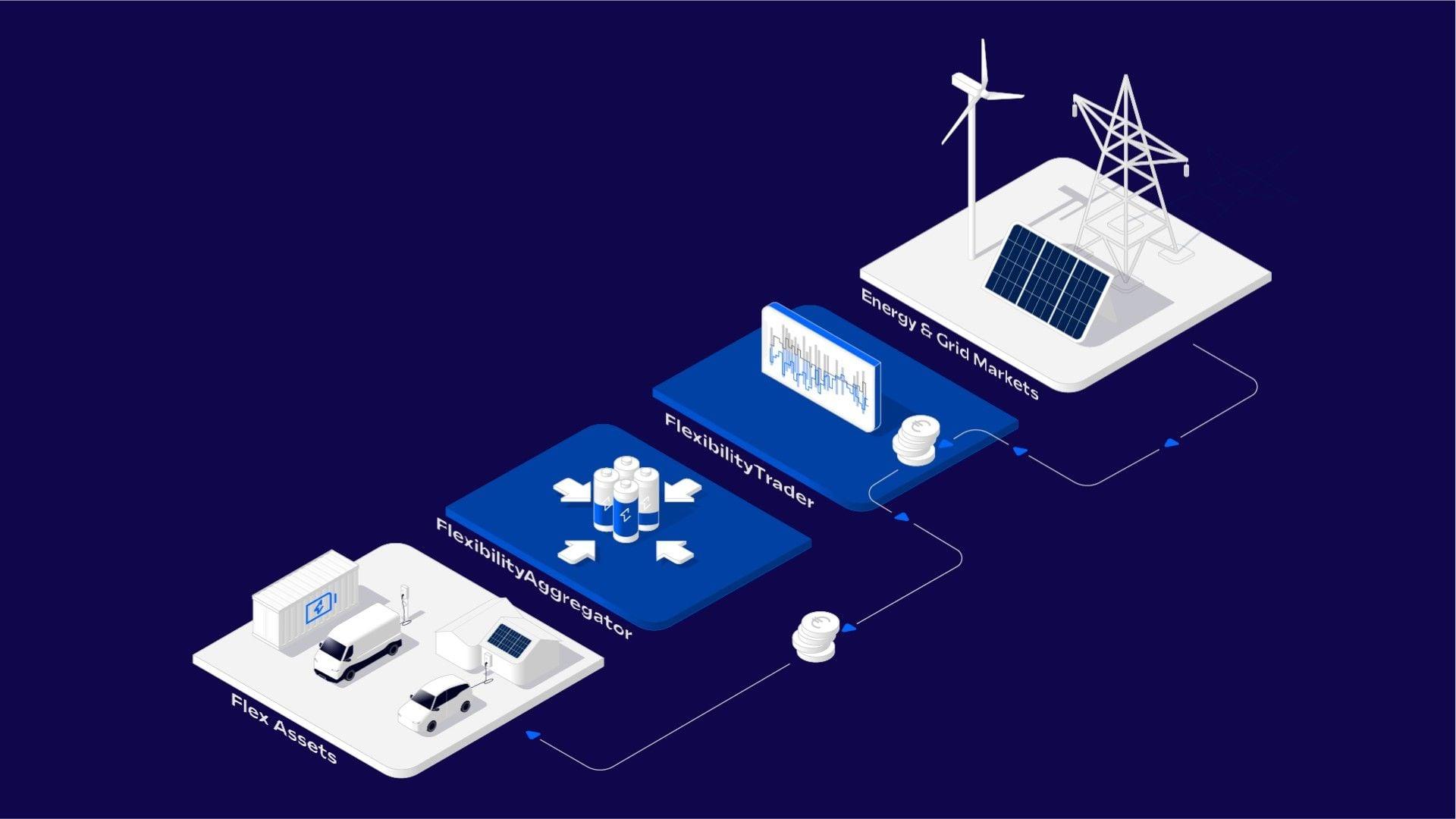
A virtual power plant (VPP) is a digitally coordinated network of numerous small, distributed energy resources—such as solar installations, battery energy storage systems (BESS), or electric vehicles (EVs). These assets are connected through a digital platform and can be monitored and controlled as a single system.
The purpose of this setup is to enable decentralized resources to be aggregated into one market-relevant unit. When pooled in this way, many small assets can operate like a conventional power plant: they can supply electricity, absorb and store surplus energy, or provide grid support services, depending on system needs. In other words, instead of relying solely on one conventional power plant, the energy system can draw on numerous smaller assets working in coordination.
How Does a VPP Based on EVs Differ from Other Virtual Power Plants?
In principle, a virtual power plant made up of electric vehicles follows the same logic as one based on photovoltaic (PV) systems or battery energy storage systems: it aggregates flexibility and makes that flexibility available to the electricity market. The key difference is mobility. Because electric vehicles are used for transport, they are not continuously available as grid resources. Much of the time, vehicles are simply parked; at other times, their battery capacity must be reserved for driving.
Unlike stationary batteries or PV systems, EVs are governed primarily by everyday mobility requirements rather than by the needs of the power system. Their batteries must also maintain a sufficient state of charge for the next trip.
In practice, availability often follows a pattern such as this:
- Morning: the EV is in use and therefore unavailable to the grid
- During the day: the EV may be parked at the driver’s workplace and may therefore be available
- Evening and overnight: the EV is plugged in at home and is often well positioned to provide flexibility
This makes EV-based virtual power plants more complex to manage than VPPs built around stationary assets—but by no means impractical. Intelligent control software can forecast when vehicles are likely to be connected, incorporate individual driving patterns, and ensure that each vehicle remains ready for use.
A key point is that the system does not draw on battery capacity indiscriminately; it uses only the share of energy that is available at a given time without compromising mobility needs. This is precisely why EV fleets can function as virtual power plants—especially at scale. When large numbers of vehicles are aggregated, they can already deliver services that were once associated primarily with conventional power plants, including grid stabilization.
Virtual Power Plants and the Potential of Vehicle-to-Grid in Germany
Virtual power plants provide the operational framework for vehicle-to-grid (V2G) applications, in which EV batteries are not only charged but can also discharge electricity back into the grid when required.
In Germany, V2G offers considerable potential that has yet to be fully unlocked. Millions of additional electric vehicles are expected on the road in the coming years, and each of them represents a potential source of mobile storage capacity. When aggregated, these vehicles amount to a substantial pool of flexible capacity. If large numbers of EVs are connected at the same time, they can help bridge supply shortfalls and support grid stability—much like a large, distributed power plant.
At present, the main barrier to a broader V2G rollout is less the technology itself than the surrounding market and regulatory framework. The encouraging news is that Germany has started to make progress in this area. New regulatory measures, including the elimination of double grid fees, are expected to make bidirectional charging significantly more attractive from an economic perspective, even if some aspects of implementation remain unclear.
In practical terms, this could lead to:
- stronger incentives for users to participate in V2G
- greater scalability for V2G business models
- meaningful integration into the energy market
The full value of V2G emerges only when large numbers of EVs participate in a virtual power plant. One vehicle has little impact; thousands can make a significant difference.
What Are the Benefits of V2G for the Power Grid and EV Drivers?
Vehicle-to-Grid adds flexibility to the power system precisely when that flexibility is needed. Through virtual power plants, EVs can become active participants in electricity markets rather than passive loads.
- Previously: electricity had to be consumed at the moment it was generated.
- With V2G: electricity can be stored temporarily and dispatched in a targeted way.
This is especially relevant in intraday trading, where electricity is bought and sold at short notice—often only a few hours ahead—and prices can change rapidly.
What role can EVs play in this context? They can charge when electricity is inexpensive—for example during periods of strong wind generation—and feed electricity back into the grid when prices are high, such as in the evening.
More importantly, V2G can also respond to local grid conditions. If bottlenecks arise in a particular region, EVs can discharge locally to help relieve pressure on the grid. If surplus electricity is available elsewhere, vehicles can be charged in a location-specific and system-oriented way. The result is a system that responds not only to wholesale market signals, but also to conditions within the distribution grid.
Put simply, V2G brings flexibility to the places and times where the power system needs it most.
Benefits for EV Owners
For EV owners, the benefits of V2G are felt most directly in financial terms. By making their vehicle’s battery capacity available for aggregation and market participation, they can be compensated for the flexibility their EV provides to the power system. In some models, remuneration is tied simply to the time the vehicle is connected to the home charging point, regardless of whether electricity is actually being charged or discharged at that moment.
If drivers make their vehicles regularly available for V2G, the resulting compensation can be substantial. Under suitable market conditions, it may be enough to offset the cost of electricity for several thousand kilometers of driving per year—making the idea of highly low-cost, or in some cases effectively “free,” driving a realistic prospect.
This is already becoming a reality in France. New Renault electric models, including the R5, support bidirectional charging. The Mobility House Energy markets the battery capacity of these vehicles in the intraday and capacity markets, generating €0.11 per connected hour for participating customers. With an average connection time of 13 hours per day, this translates into savings of around €40 per month—enough to cover the electricity required for roughly 10,000 kilometers of driving per year.
V2G in Germany: Where Does The Market Stand in 2026?
When it comes to V2G, Germany currently sits somewhere between “technically feasible” and “not yet part of everyday reality.”
The technology itself is already functioning: the first series-produced vehicles with V2G capability are on the market, and pilot projects are underway—including some at larger scale. What has not yet happened, however, is a broad market rollout. In that sense, Germany is still in the early stages. In market terms, the country remains in an early stage of development.
Why is that?
- For a long time, the regulatory framework acted as a constraint—for example through double grid charges.
- Technical standards have not yet been fully harmonized.
- Not every EV and not every home charging system is capable of bidirectional charging, even if many products are already being marketed as “bidi-ready.”
That said, the direction of travel is clear. In our view, 2026 will mark the transition from pilot projects to large-scale deployment.
The Mobility House Energy is helping to drive this development. One example is our partnership with Mercedes-Benz: In October 2026 we jointly launched the bidirectional charging offer MB.CHARGE Home Pro Intelligent.
What Are the Challenges of Bidirectional Charging?
To address some common misconceptions, it is worth taking a closer look at the technical and market-related challenges that still remain.
- Challenge 1: Availability
EVs are not stationary storage assets. At times they are plugged in; at others they are on the road. The amount of battery capacity available at any given time also depends on how the vehicle is used and charged. This makes coordination more complex than in the case of stationary storage.
This can be addressed through forecasting and the integration of user-defined preferences. The system can plan around expected availability, but mobility needs always take priority. Drivers can communicate their requirements, e.g. via an app.
- Challenge 2: OEM Warranty Conditions
Battery health remains a sensitive issue. Not all manufacturers currently permit bidirectional charging or commercial use of the battery. This is due in part to the lack of harmonized standards and in part to continuing uncertainty around viable business models. That situation is beginning to improve.
- Challenge 3: The Effect of V2G on Battery Degradation
Yes, vehicle-to-grid operation does affect the battery—but far less dramatically than is often assumed. All batteries degrade over time as a result of use.
V2G introduces additional charge-discharge cycles. In practice, however, these cycles are typically shallow, take place within optimized operating windows rather than across the full 0–100% range, and are managed intelligently. Studies on battery lifetime optimization, along with practical experience, indicate that the additional wear is often moderate and can be economically offset.
The real bottleneck to scaling V2G is therefore not the core technology itself. What is needed for broad deployment is a clear regulatory framework, appropriate economic incentives, and user trust in the technology.
Only when these conditions are in place can a promising concept become a functioning system.