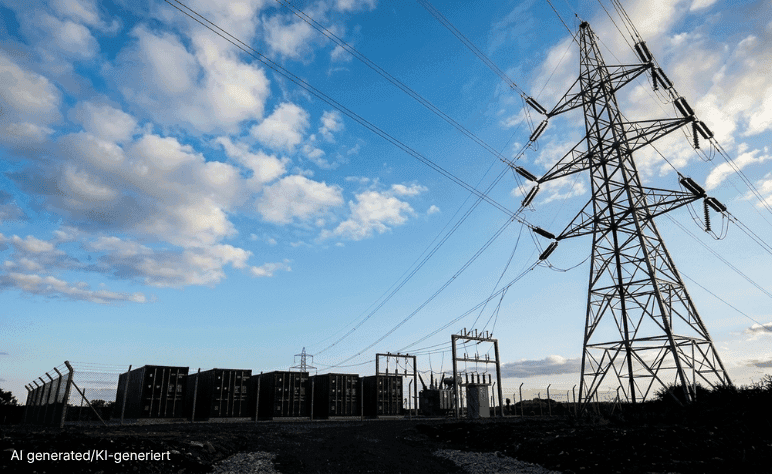
Anyone looking to connect renewable energy sources or energy storage systems to the grid today faces the same obstacle: the grid connection. It has become the bottleneck of the energy transition. The volume of planned projects far exceeds the number of available grid connections.
And this situation is set to persist for some time. Consequently, Flexible Connection Agreements (FCAs) have become the standard for new BESS projects.
BESS investors often misjudge the impact of such curtailment constraints on revenues. In this blog post, we explain the background of FCAs and leverage our practical experience as a flexibility marketer to demonstrate how such an agreement can affect your BESS revenues.
What Are Flexible Connection Agreements for BESS?
A Flexible Connection Agreement is a contract between an asset operator and the responsible Distribution System Operator (DSO). While an unrestricted grid connection specifies that an asset is permitted to feed in or draw full capacity at any given time, an FCA overrides this principle.
Under an FCA, the grid connection is conditional upon the DSO's right to impose general constraints at the grid connection point.
For Battery Energy Storage Systems (BESS), FCAs mean that the battery can no longer react solely to price signals from electricity markets. Instead, it must prioritize the local distribution grid's conditions. These constraints can take many forms, ranging from ramp rate limits and reactive power requirements, to restrictions on providing ancillary services (balancing power), to specific operational envelopes and active power curtailment curves for co-located renewable installations, or even the temporary, direct control of the BESS by the DSO for a defined number of hours per year.
While Flexible Connection Agreements are often presented as an elegant compromise to accelerate the grid integration of storage projects in congested areas, reality shows that FCAs do not just speed up projects—they often make them viable in the first place.
Why Do FCAs Exist?
The actual bottleneck lies within the distribution grids. Due to the massive, decentralized expansion of renewable energy, grids must absorb vast and highly fluctuating volumes of electricity. So far, Germany’s numerous distribution system operators (DSOs) have met this challenge with slow expansion and digitalization efforts across their medium-voltage networks.
To make matters worse, a large portion of the distribution grid lacks digitalization. Many German DSOs operate with a relative lack of visibility, as they have no real-time transparency regarding local power flows within their networks.
To safeguard grid stability, new flexible assets like battery storage systems can no longer react blindly and exclusively to nationwide price signals (such as Day-Ahead or Intraday market prices). Instead, they must accept DSO-imposed constraints in the form of FCAs to secure a grid connection agreement in the first place.
What Types of FCAs Are There?
To date, there is no standardization regarding how exactly grid connections are restricted. Major DSOs have recently published their own standard FCAs, and the battery storage industry hopes that most other operators will follow their lead.
Broadly speaking, FCAs can be categorized into commercial, temporary, or physical-technical constraints. These parameters can either apply constantly (statically) throughout the entire year or be modulated dynamically by the grid operator on an as-needed basis. Some are time-limited, while others are permanent.
Common examples of constraints under flexible connection agreements include:
- Ramp rates / power gradients (e.g., 6-20% Pmax/min)
- Feed-in or export/import restrictions based on regional PV and/or wind generation (site-specific and/or time-dependent)
- Reactive power provision (sometimes exceeding the German VDE-AR-N 4120 grid code standard)
- Restrictions on providing ancillary services (balancing services)
- Redispatch obligations
For major players among BESS project developers, dynamic grid connection management is the gold standard. Unlike rigid FCA rules, it adjusts the allowable capacity at the grid connection point in real time based on actual grid conditions. This grants the BESS more operational headroom when the grid has capacity, curtailing output only when strictly necessary. Developers who invest in the required metering and communication infrastructure actively help the DSO gain the real-time visibility needed to understand their grid in the first place.
Example A: Ramp-rate constraints
Ramp-rate limits are one of the most common FCA restrictions. They define how quickly a BESS can increase or decrease its power output (as a percentage of rated capacity per unit of time) and typically apply to spot market operations.
One of the key advantages of batteries is their near-instantaneous response time. A well-configured BESS can switch from full discharge to full charge within milliseconds. This is precisely what makes them so valuable in intraday and balancing markets.
Imposing a ramp rate fundamentally changes this:
- At a 6% ramp, it takes more than 16 minutes to move from 0% to 100% output
- At a 20% ramp, it still takes 5 minutes
In other words, the asset loses its most valuable capability: speed.
Example B: Restrictions on ancillary services
Ancillary services such as FCR and aFRR have traditionally formed the financial backbone of many BESS projects.
FCR requires full activation within 30 seconds in response to frequency deviations. FCAs do not entirely block FCR provision: in any case, FCR is regulatory-capped at 25% of the maximum BESS capacity, which inherently mitigates its impact on the local grid. Furthermore, ancillary services currently maintain priority, even under redispatch conditions.
Nevertheless, FCAs can further restrict the permissible ancillary service capacity. For instance, a DSO may constrain a 50 MW BESS via a Flexible Connection Agreement such that only a maximum of 5 or 10 MW is cleared for FCR provision. The remaining capacity must then be utilized exclusively for day-ahead or intraday trading.
How do FCAs impact BESS revenues?
There is no question: FCAs reduce BESS revenues. The magnitude depends on two factors:
- the specific design of the FCA
- how the asset is optimized
Historical data and detailed simulations show that restrictive import/export limits can reduce annual revenues by 20–30% if the asset is not optimized intelligently. However, a sophisticated multi-market strategy can mitigate a large share of these losses.
Let’s look at two scenarios:
Example A: Impact of ramp rates
The extent to which a ramp rate limits revenues depends heavily on the operational and optimization strategy. It makes a critical difference whether the battery is operated purely for energy trading or managed via intelligent multi-market optimization that simultaneously serves all available markets (arbitrage, FCR, and aFRR).
Scenario 1: Smart Multi-market optimization
If the asset is operated using an advanced algorithm that dynamically allocates capacity across arbitrage and ancillary services, the negative impact of ramp constraints can be significantly reduced:
- 6% ramp (highly restrictive): revenue reduction of 6–9% €/MW/year
- 20% ramp (moderate): revenue reduction of only 1–3% €/MW/year
However, this scenario assumes that ancillary services remain attractive. If these markets become saturated and revenues decline, optimization shifts toward energy trading, where ramp constraints have a much stronger impact.
Scenario 2: Trading-only operation
If the BESS is forced into pure wholesale trading (e.g., due to regulatory constraints or declining ancillary service revenues), ramp limits become critical.
Here's why: Intraday trading relies on capturing short-term price spikes and system imbalances. If a battery needs more than 15 minutes to ramp up, it simply cannot capture these opportunities.
- Impact: revenue losses of 15–35% €/MW/year
Example B: Impact of ancillary service restrictions
In many European markets (including Germany, Austria, and the Netherlands), ancillary services still account for a large share of BESS revenues. Although increasing BESS deployment is putting downward pressure on prices, these markets remain an important revenue pillar.
If FCA constraints limit participation, for example, reducing eligible capacity from 50 MW to 5 MW, this revenue stream largely disappears. The asset is then forced into volatile energy markets. If price spreads are tight, the overall business case deteriorates significantly. A robust pre-FID simulation of this risk is therefore essential.

BESS whitepaper available for download
How are BESS revenue streams changing? And how can intelligent cycling strategies help protect the long-term value of a battery asset? Find out more in our free whitepaper.
The Mobility House Energy: Experienced in Managing FCAs
At The Mobility House Energy, we already optimize complex FCA-constrained BESS assets across multiple European markets, including a large-scale project exceeding 200 MW with sophisticated ramp-rate logic.
In another project, we operate a co-location system with a shared grid connection and additional constraints on aFRR participation. When the PV plant is generating at full capacity, the available headroom for the BESS is reduced accordingly.
Based on this experience, we can quantify the impact of FCAs on project revenues before final investment decisions are made. For many common FCA structures, we already have pre-built simulation models. For more complex setups, we develop tailored simulations aligned with your specific system design.
Our Advice: How to Approach FCA Negotiations
While the room for negotiation with grid operators is often limited, it does exist. We advise BESS developers never to blindly accept the standard specifications issued by DSOs.
The following strategies have proven effective in practice:
1. Validate reference assets
DSOs often base constraints
on reference assets. Ensure these are connected to the same substation, not a
different grid node. Otherwise, the comparison is not meaningful.
2. Commission an independent grid study
Do not rely
solely on the DSO’s assumptions. An external grid simulation provides a solid
basis for negotiation and helps challenge overly conservative constraints.
3. Scrutinize breakpoints and ramp rates
These are often
applied generically without considering the specific grid environment. It is
advisable to verify, for instance, whether there are large industrial
consumers near the grid connection point whose consumption patterns would
actually justify such constraints.
4. Propose a pilot for dynamic curtailment
Instead of
static limits, suggest a dynamic approach. This is more grid-friendly and
allows significantly greater operational flexibility.
5. Stay on top of regulatory developments
Currently,
BESS operators must fix schedules up to 60 minutes in advance, limiting
intraday flexibility. However, upcoming regulatory changes (e.g., Germany’s
“Planwertverfahren”) are expected to improve this. Make sure your FCA includes
clauses that allow future adjustments.
Conclusion: FCAs are no death sentence for BESS revenues
The extent to which a Flexible Connection Agreement impacts BESS revenues depends heavily on the specific design of the FCA and the chosen monetization strategy. While restrictive requirements can lead to substantial revenue losses in pure trading setups, practice shows that intelligent multi-market optimization can buffer most of these losses.
A proactive, informed approach to FCAs is therefore critical, ranging from robust simulations prior to the investment decision to actively negotiating connection terms. By understanding the technical and regulatory leeway, you can deliver commercially viable projects even under highly restrictive conditions.