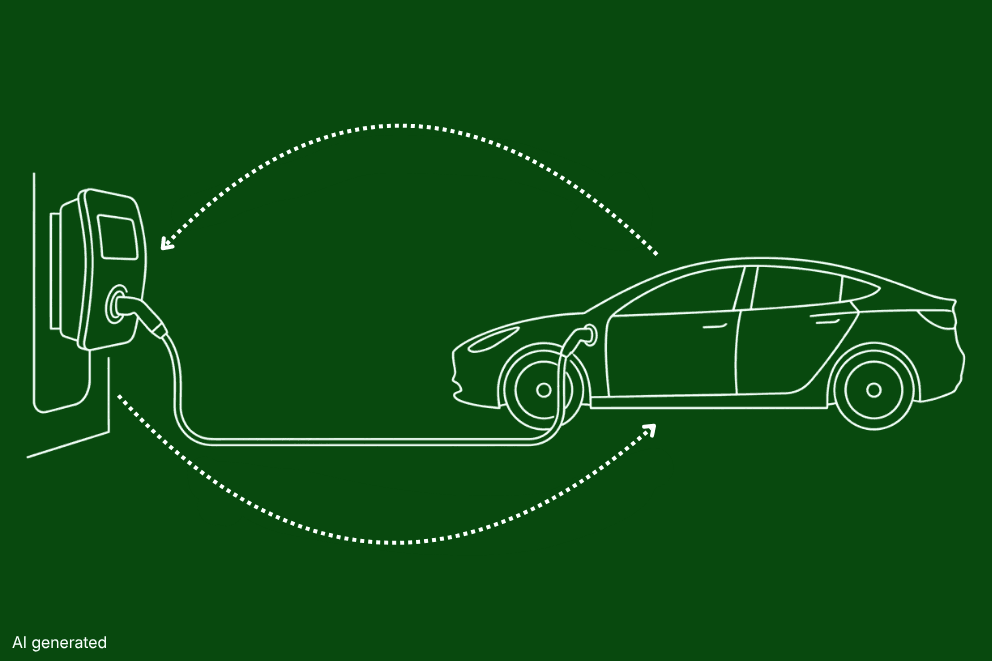
Until a few years ago, discussions around electric vehicles mostly revolved around range, charging times, and plug standards. Now, a new topic is taking center stage: bidirectional charging.
2026 is shaping up to be a major turning point for this innovation. Bidirectional charging is no longer a distant vision—it is becoming a reality. In this article, you'll learn how the technology works, what it looks like in practice, and how it can pay off financially.
What Is Bidirectional Charging?
Bidirectional charging refers to the ability of an electric vehicle not only to draw electricity, but also to feed the energy stored in its battery back out in a controlled manner when needed, whether into the public grid, your household or to external devices.
With conventional (unidirectional) charging, energy flows strictly in one direction: from the grid to the vehicle. Bidirectional charging transforms EVs from passive energy consumers into a flexible, mobile energy storage systems. This opens up a range of practical applications and holds immense potential for the decarbonisation of the energy system.
Forms of Bidirectional Charging
In practice, bidirectional charging comes in several different forms, collectively referred to under the umbrella term V2X (Vehicle-to-Everything). The "X" acts as a placeholder for whichever destination receives the electrical energy.
Here are the key concepts:
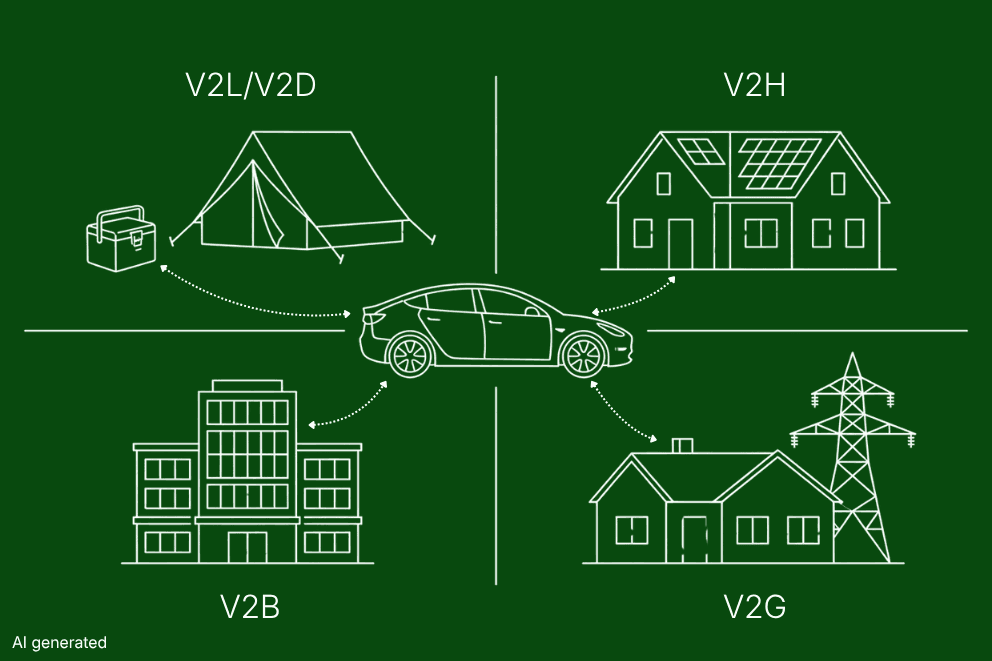
Vehicle-to-Load (V2L) / Vehicle-to-Device (V2D)
With V2L, the electric vehicle acts as a mobile power bank for individual electrical devices. Energy is drawn either through standard household sockets inside the vehicle or via a special discharging adapter plugged into the car’s charging port. In Germany, there are no regulatory hurdles standing in the way: anyone with a V2L adapter can use it.
Use case: Off-grid power supply, such as while camping or at construction sites.
Vehicle-to-Home (V2H)
V2H involves integrating the vehicle into a household electrical system. Connected via a bidirectional wallbox, the EV effectively doubles as a stationary home storage battery. Achieving seamless integration requires a perfectly synchronized ecosystem. The Mobility House Energy is developing an integrated home energy solution specifically for this purpose.
Use case: You can store excess solar power generated by your rooftop PV system during the day in your car's battery, and use it to power your household in the evening and overnight. This significantly boosts your self-consumption, slashes your electricity bills, and reduces your dependence on conventional energy utilities.
Vehicle-to-Building (V2B)
This principle scales the V2H concept up to commercial properties, larger buildings, or corporate fleets. Multiple vehicles are networked together intelligently to supply power to a building. A key application is peak shaving, i.e. smoothing out demand spikes to lower grid fees for commercial enterprises.
Vehicle-to-Grid (V2G)
Vehicle-to-Grid represents the most technologically advanced form of bidirectional charging. Here, energy from the vehicle battery is fed directly back into the public power grid.
When your EV is connected to a V2G system, its battery capacity is actively traded on the energy market, lowering your overall mobility costs, potentially even down to zero.
Beyond personal savings, V2G solves a core challenge of the energy transition: the lack of flexible, decentralized storage capacity needed to balance and stabilize the power grid.
>> Want to learn more? Check out our dedicated Vehicle-to-Grid (V2G) info page for a deep dive into the benefits and answers to key questions.
How Does Bidirectional Charging Work?
The underlying principle of bidirectional charging is simple: energy no longer flows solely into your EV, it can also flow back out when needed. Two steps are neccessary:
Step #1: Energy Conversion
In Germany, the power grid and household appliances operate on alternating current (AC). Batteries, however, can only store energy as direct current (DC). To feed energyback out, it must be converted. This is handled either directly inside the vehicle via an integrated on-board charger or externally within a bidirectional wallbox.
Step #2: Aggregation into a Virtual Power Plant
If you want to feed energy back into the public grid to generate income (V2G), the electricity market comes into play.
Because the battery of a single EV is far too small to participate in the wholesale power market on its own, your EV is digitally networked with thousands of others to form a single, massive virtual fleet.
A service provider like The Mobility House Energy automatically manages this swarm using an intelligent software platform. Your car charges when electricity on the market is cheap or even free, and feeds power back into the grid during peak demand, when energy prices reach their highest point. The trading profits generated through this process are paid out to you as a bonus.
>> Learn more here about how virtual power plants work for electric vehicles.
The Benefits of Bidirectional Charging
What's driving so many leading automakers to drive bidirectional charging forward is its compelling economic and environmental benefits.
Benefits for EV Owners
Bidirectional charging can significantly reduce the ongoing operating costs of your EV, and it may make driving it virtually free. This is achieved through the synergy of three effects:
- Maximizing PV Self-Consumption (V2H): During the day, you store excess self-generated solar power directly in your vehicle’s battery rather than feeding it into the grid at low feed-in tariffs. During expensive evening and morning hours, you use this stored energy to power your home.
- Leveraging Dynamic Electricity Tariffs: Even without your own rooftop PV, your system automatically charges your car during periods when wholesale electricity prices are exceptionally low (or even negative) due to high wind or solar generation on the grid.
- Generating Revenue on the Energy Market (V2G): Temporarily stored energy is sold back to the power market at premium prices during peak demand periods. By systematically taking advantage of these price spreads, you can generate a steady stream of revenue that noticeably lowers your annual electricity and mobility expenses.
Benefits for the Power Grid
Ever-growing volumes of renewable energy pose a challenge for the public power grid because generation and consumption are often misaligned in both time and location. For example, large amounts of solar power are generated around noon when overall consumption is relatively low. Similarly, vast amounts of wind power produced in northern Germany are needed down in the south. This pattern plays out in other countries, too.
Bidirectional charging helps solve this challenge by:
- Providing Flexibility: Parked EVs act as decentralized buffer storage units that can absorb energy or feed it back into the grid on short notice.
- Mitigating Dunkelflauten and Demand Peaks: During periods without wind or sun (“dunkelflaute”), EV batteries support the grid. Conversely, they relieve pressure on the system during consumption peaks.
- Smoothing Out Generation Peaks: Midday spikes in solar generation are buffered directly within vehicle batteries instead of overloading the grid network.
Benefits for Society, the Economy, and the Climate
Both the environment and society stand to gain significantly from V2G:
- Reducing Grid Expansion Costs: Given that cars sit unused for an average of 23 hours a day anyway, we can utilize their existing batteries as intermediate storage. This reduces the need to build costly new power lines.
- Preventing Grid Overloads: If the power grid threatens to become unstable in a specific area due to a surplus or deficit of energy, connected EVs can balance it locally in real time. This avoids expensive emergency interventions by grid operators.
- Replacing Fossil Fuel Power Plants: Every kilowatt-hour of electricity an EV feeds back into the grid replaces energy generated by gas or coal plants. Because these fossil fuel plants are expensive to operate, they often set wholesale energy prices. Keeping them offline thanks to EV battery storage lowers power prices for everyone.
- Reducing Green Energy Waste: On particularly windy or sunny days when too much energy is generated, wind and solar farms are often curtailed to prevent grid overloads. With bidirectional charging, this green energy can simply be stored in the batteries of thousands of EVs.
>> Vehicle-to-Grid is being extensively researched. Read a summary of the latest studies on V2G in Europe.
Challenges in Implementing Bidirectional Charging in Germany
Despite these clear economic and environmental benefits, the widespread rollout of bidirectional charging still faces a few hurdles. The three main challenges for the German market are:
- Sluggish Smart Meter Rollout: Implementing V2G requires the widespread deployment of smart metering systems. Smart meters can record power flows with minute-by-minute precision. Unlike other European countries, Germany is lagging significantly behind: fewer than 6% of German households (as of July 2026) are equipped with a smart meter, while countries like Denmark, Sweden, and the Netherlands have already achieved full coverage.
- Regulatory Hurdles: Although laws eliminating double grid fees and taxes have been passed, their practical implementation is lagging behind. The Federal Network Agency (Bundesnetzagentur) is working on new guidelines to ensure seamless billing without red tape. Furthermore, the over 800 regional distribution grid operators across Germany must first adapt their software systems and interfaces to these new digital standards.
- Hardware Costs: Standard existing wallboxes are not capable of bidirectional charging. EV owners looking to use V2H or V2G, will need to invest in new hardware.
By contrast, a common concern among vehicle owners—the potential negative impact on battery lifespan—is unfounded: bidirectional charging has been found to not cause significant battery degradation.
Which Equipment is Needed for Bidirectional Charging?
To make the system technically operational and financially viable in Germany, three key components must be in place:
- A Compatible EV and a Bidirectional Wallbox: Both devices must be explicitly designed for two-way energy flow and activated via software.
- A Home Energy Management System (HEMS): For home use (V2H), this software coordinates the power flow between your home’s appliances, PV system, and vehicle battery. (Note: A HEMS is not strictly required for V2G).
- A Smart Meter in Your Fuse Box: A smart metering system (iMSys) accurately records your energy feed-in and electricity consumption in real time.
Which EVs Support Bidirectional Charging?
One of the most pressing questions for EV owners is: Can my current or future EV actually feed energy back out?
The short answer is promising: in Germany, many automakers already offer
V2G-compatible models or are about to launch them.
Overview of V2G-capable electric vehicles by manufacturer, launch year, and technology (as of July 2026):
|
Manufacturer |
Models |
Launch Year |
Technology |
|---|---|---|---|
Audi |
Q4 e-tron |
2023 (SW 3.5+) |
DC |
BMW |
iX3 |
2026 |
DC |
BYD |
Atto 3, Seal, Dolphin |
2025 |
AC |
Cupra |
Born, Tavascan |
2023 (SW 3.5+) |
DC |
Fiat |
- |
in projects |
DC |
Ford |
Explorer, Capri (EU) |
2023 |
DC |
Honda |
- |
in projects |
DC |
Hyundai |
Ioniq 9 |
2025 |
AC |
Kia |
EV9 |
2024 |
AC |
Mercedes-Benz |
CLA, GLC, GLB, C-Klasse, VLE, AMG GT |
2026 |
DC |
Nissan |
Juke |
2027 |
AC |
Renault |
R5, R4, Mégane, Scénic, Twingo, A290 |
2024 |
AC |
Skoda |
Enyag, Elroq |
2023 (SW 3.5+) |
DC |
Toyota |
- |
2027/2028 |
AC |
Volkswagen |
ID.3, ID.4, ID.5, ID.7, ID. Buzz |
2023 (SW 3.5+) |
DC |
V2G has largely arrived at the market launch stage among the automotive brands surveyed. 13 out of 15 brands have announced a specific vehicle or rollout timeline. DC technology dominates, with ten manufacturers opting for DC compared to five for AC. At the same time, the varying timelines show that V2G is still in different stages of development depending on the brand and model.
Source: Data based on manufacturer information and market analyses. EVs and BEVs only. Subject to change.
>> If you’d like to learn more about specific manufacturer
offerings and future plans, check out our article: Which EVs support V2G?
Which Home Chargers Support Bidirectional Charging?
Just like traditional unidirectional charging, V2G relies on either AC (alternating current) or DC (direct current) chargers.
Because EV batteries can only store DC power while the public grid always operates on AC, energy must be transformed whenever it flows in or out of the vehicle:
- AC Charging Stations: transformation takes place directly inside the vehicle via its integrated on-board charger.
- DC Charging Stations: transformation is handled entirely within the home charger itself.
It is also worth keeping in mind that converting energy incurs minor efficiency losses—typically between 5% and 10%, depending on the specific technical solution. Both approaches come with their own distinct advantages and drawbacks.
Bidirectional chargers: overview by manufacturer, maturity, and technology (as of July 2026)
|
Manufacturer |
Maturity |
Technology |
|---|---|---|
ABB |
pilot stage |
DC |
Ambibox |
production ready |
DC |
EVTEC |
production ready |
DC |
E3/DC |
production ready |
DC |
Enphase |
announced |
DC |
Hager |
production ready |
DC |
Indra |
pilot stage |
DC |
KEBA |
announced |
DC |
Sigenergy |
production ready |
DC |
SolarEdge |
angekündigt |
DC |
StarCharge |
production ready |
DC |
The Mobility House Energy |
production ready |
DC |
Wallbox |
pilot stage |
DC |
Zaptec |
production ready |
AC |
An overview of 14 manufacturers of bidirectional home chargers. Six manufacturers offer production-ready products, five are deploying them in pilot projects, and three have announced solutions. 13 manufacturers use DC technology, while Zaptec uses AC.
Source: Data based on manufacturer information and market analyses. EU and BEVs only. Subject to change.
Bidirectional Charging Combined with Solar (PV) Systems
For homeowners, Vehicle-to-Home (V2H) is a particularly compelling application: it allows you to maximize the self-consumption of your solar power, cut energy costs, and gain greater independence from utility companies.
While the benefits of V2H solar integration are undisputed, fully integrated consumer solutions in the German market are still in the rollout phase (as of mid-2026).However, key industry leaders—including The Mobility House Energy—are currently developing comprehensive, plug-and-play home solutions that will soon bridge this gap.
FAQ: Frequently Asked Questions About Bidirectional Charging
Conclusion: Is Bidirectional Charging Worth It?
The technology, standards, and vehicles for bidirectional charging are market-ready, and major regulatory hurdles in countries across Europe are rapidly falling.
In Germany, wihile some tax nuances remain—such as electricity tax exemptions currently applying primarily to fed-back self-generated PV power—the financial case for bidirectional charging is already proven. For example, partnerships between Renault, Mobilize, and The Mobility House Energy in France enable retail customers to save up to €600 per year (equivalent to roughly 10,000 km of free driving).
If you are planning to purchase a new home charger or EV, choosing hardware that supports bidirectional charging is a smart, future-proof decision. It allows you to dramatically reduce your EV operating costs while playing an active role in achieving net zero.