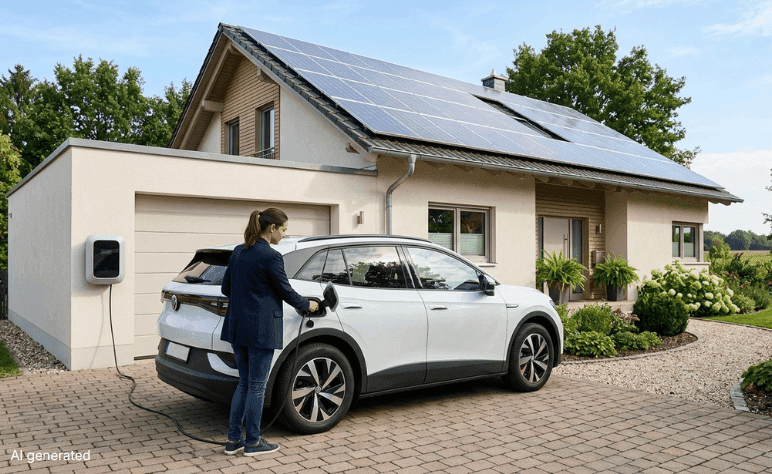
The promises surrounding bidirectional charging almost sound too good to be true: driving an EV for free, getting paid to charge instead of paying for it, and using your own car as a mobile battery storage system for self-generated solar power. Lower energy costs and greater independence.
Can this really be true, or is there a catch? In this article, we take a realistic look at the two most important forms of this technology – Vehicle-to-Grid (V2G) and Vehicle-to-Home (V2H) – and clear up whether bidirectional charging is actually worth it for users in Germany.
What is Bidirectional Charging?
Bidirectional charging refers to an electric vehicle's ability to not only draw power from the grid (i.e., charge) but also feed that energy back into a home or the grid ( i.e., discharge).
>> Read our previous blog post to dive deeper into what's behind bidirectional charging.
The core idea of bidirectional charging is to tap into the substantial storage capacity of EV batteries while vehicles are parked, which is the case for an average of 23 hours a day.
Vehicle-to-Grid: Lowering Operating Costs and Generating Revenue with Your EV
Vehicle-to-Grid (V2G for short) refers to feeding energy stored in an EV battery back into the public power grid. Electric vehicles can absorb excess renewable energy and discharge it when demand peaks. This helps balance the fluctuating supply of wind and solar power and reduces the curtailment of renewable generation. At the same time, EV owners can generate revenue: electricity is drawn when prices are low and sold back when prices are high.
To allow your EV battery to trade on the energy market, an aggregator (such as The Mobility House) bundles it with many other EV batteries to create a virtual power plant. A digital platform manages and controls the vehicles based on electricity prices, grid demand, state of charge, manufacturer warranty terms, and individual driving needs. The resulting revenues are shared with you and other participating vehicle owners. Your mobility always remains the priority—you can set parameters like a minimum battery level and your expected departure time yourself.
➡️ Key takeaway: Vehicle-to-Grid can help you charge your electric car more affordably and earn extra income, all while your battery helps stabilize the power grid.
Vehicle-to-Home: Storing Solar Power and Cutting Costs with Your EV
Vehicle-to-Home (V2H for short) means using the electricity stored in your car's battery to power your home. Unlike V2G, this energy isn't fed into the public grid for general use, rather it stays within your household so you can consume it directly.
This is especially effective when combined with a home solar system. By using your EV battery as a storage system, you can consume more of the solar energy you generate yourself.
The main benefit of V2H is load shifting: power generated during the day can be stored for use in the evening.
Even without a PV system, V2H can make financial sense when paired with a dynamic electricity tariff. In this case, the car charges when electricity prices are lowest, storing energy for later use in your home. When purchasing a home charger or energy management system, make sure the device is compatible with your preferred tariff or energy provider.
➡️ Key takeaway: Vehicle-to-Home helps you consume more of your own solar power or shift your electricity consumption to off-peak, cheaper hours.
By the way: If you choose a compatible home charger, you can also use your EV for V2G down the road to generate extra income.
Who Can Use Bidirectional Charging Today?
The prerequisites for the V2G solutions currently available in Germany include a compatible electric vehicle, a bidirectional home charger, and a parking space with access to a smart meter. For Vehicle-to-Home, you also need a Home Energy Management System (HEMS).
Currently, V2G is not available in Germany for commercial fleets or households without a smart meter; households with PV systems are also excluded at this time.
Which EVs Support Bidirectional Charging?
You can find a list of V2G-compatible cars on our blog. Compatible EVs include models from the Volkswagen Group with ID. Software version 3.5 or higher and a battery capacity of at least 77 kWh.
Although more than two million EVs are registered in Germany as of April 2026, this still represents only a fraction of all cars in the country. Out of those two million, only a small portion is currently capable of bidirectional charging.
The number of compatible EVs is expected to grow significantly over the coming years. As bidirectional charging standards become widespread and hardware costs drop, bidirectional charging will likely become a standard feature in new vehicles.
Which EV Chargers Support Bidirectional Charging?
To use V2G or V2H, you need a specialized bidirectional EV charger, which means investing in new hardware.
Bidirectional-capable home chargers come in two variants: AC and DC solutions.
With AC chargers, the inverter inside the vehicle handles the conversion between alternating current (AC) and direct current (DC). This keeps the charger relatively simple and affordable, but the vehicle itself must support the bidirectional technology. Very few mass-produced EVs currently offer this, and most available AC home chargers advertised as "BiDi ready" have not yet been tested with compatible cars.
With DC home chargers (such as the ChargeLine BiDi from The Mobility House), the inverter is built directly into the charging station. While they are more complex and expensive, DC home chargers currently dominate the market because they allow bidirectional features to be integrated into charging infrastructure in a standardized, regulatorily scalable way.
Both solutions experience minor efficiency losses of five to ten percent during energy conversion, along with standby consumption and minimum discharge power requirements.
➡️ Key takeaway: Although vehicle selection and market offers remain limited and hardware costs are relatively high, bidirectional charging can already pay off long-term for early adopters ready to invest.
Is Vehicle-to-Grid Worth It in Germany?
This year, the first Vehicle-to-Grid offerings launched or were announced in Germany by BMW, Mercedes-Benz (with MB.CHARGE Home Pro Intelligent), Volkswagen Group, Ford, and Renault.
These offerings are structured very similarly: you receive compensation for every hour your electric vehicle is connected to a bidirectional home charger. In total, this results in a maximum potential annual revenue of between €360 and €720 per vehicle. Providers often convert this total bonus into free driving mileage.
|
Offer |
Bonus per hour connected |
Annual savings |
Free mileage |
Notes |
|---|---|---|---|---|
|
BMW (with E.On) |
€0.24 |
up to €720 |
up to 14,000 |
available for BMW iX3 Neue Klasse; €700 discount on the wallbox for the first 100 customers; two electricity contracts required; 42 cents compensation per kWh fed into the grid |
|
Mercedes-Benz (with The Mobility House Energy) |
€0.1175 |
unlimited |
unlimited |
initially available for the Mercedes-Benz GLC and the new C-Class,
with more models to follow; every connected hour is remunerated, with
no daily, monthly, or annual limits; |
|
Volkswagen Group (with The Mobility House Energy) |
to be announced |
up to €720 (in the first year) |
up to 15,500 |
bonus payment only applies after 3 hours of charging per session; maximum revenue based on 250 connected hours per month; limited number of customers. |
|
Renault (with The Mobility House Energy) |
to be announced |
to be announced |
to be announced |
n/a |
|
Ford (with Octopus Energy) |
not specified |
up to €360 |
up to 17,300 (assumed mileage of 15kWh/100km) |
available for Ford Explorer and Ford Capri; at least 300 connected hours per month; requires an electricity contract with Octopus, which includes a discount of 18 cents/kWh (= effective charging price of 15 ct/kWh). |
*Example calculation for a Mercedes-Benz GLC (average consumption: 15.8 kWh/100 km) when signing up for the Mercedes-Benz Intelligent Pro Eco tariff
When assessing potential revenues, charging and conversion losses must also be factored in: not all energy drawn by the vehicle will be available to feed back later. When compensation is based on a rate per hour plugged in, these losses are usually already built into the provider's calculation; when compensation is paid per kilowatt-hour fed back, they directly impact your actual earnings.
Are These V2G Earnings Realistic?
But are the required 250 hours per month for Volkswagen and 300 hours for Ford actually realistic? In other words, can the average consumer really earn the maximum annual V2G revenue advertised, or are these figures simply unrealistic marketing promises?
Let’s do the math: 250 or 300 hours per month translates into a daily connection time of just over 8 or just under 10 hours, respectively. If we assume that you only connect your vehicle to the wallbox overnight, it would need to be connected, for example, from 6 p.m. to 2 a.m. or 4 a.m., or from 10 p.m. to 6 a.m. or 8 a.m. Normally, most cars are parked in their owners’ garages during these hours.
In general, cars in Germany spend more time parked than being driven. On average, they travel about 12,500 kilometers per year. While they are not exclusively parked in their owners’ garages for the average 23 hours a day, cars belonging to homeowners do spend a large proportion of their time there.
It is also worth noting that V2G offerings typically have an upper limit. In other words, the maximum revenue is capped. If you make your vehicle available for bidirectional charging for longer than the required number of hours, you will not receive any additional bonus.
As long as your vehicle remains connected, however, its battery can generally still be used for energy trading. You simply won’t receive any additional compensation for this—unless the V2G offering includes payment for the energy actually fed back into the grid, as is the case with BMW and E.ON, for example. You can prevent this by deactivating the V2G function once you have reached the monthly limit.
➡️ Key takeaway: The annual bonuses and free mileage promised by various V2G offerings are indeed realistic.
Is Vehicle-to-Home Worth It in Germany?
Vehicle-to-Home sounds attractive, promising greater independence from traditional energy providers and lower energy costs. But whether it is actually worth it depends on the specific circumstances.
Case 1: Single-family home with a PV system
If excess solar power generated by your rooftop system is stored instead of being fed into the grid, it can be used to power your household later. This allows you to make greater use of the electricity you generate yourself. To do so, you can either use a relatively affordable home battery or, with V2H, the battery of your electric vehicle.
An EV battery has a significantly larger storage capacity than a typical home battery, but that doesn’t necessarily mean V2H provides greater benefits. Once a household’s primary electricity needs have been met, additional storage capacity offers only limited added value: the car may be able to store more electricity, but that doesn’t mean the household will consume more.
To use an EV battery cost-effectively, the home battery and the vehicle also need to be coordinated, for example through an energy management system. If there is no home battery, V2H is only worthwhile if the savings on grid electricity outweigh the conversion losses and upfront costs.
In addition, many EVs require a minimum power output when discharging, which can be higher than a household’s electricity consumption. This means the vehicle battery cannot always be used according to the household’s actual needs.
Case 2: Single-family home without a PV system
V2H can also be interesting if you don’t have your own PV system but use a dynamic electricity tariff. In this case, the vehicle charges when prices are low (e.g. around midday) and later supplies the household when electricity is more expensive (such as in the evening).
As with a home equipped with a PV system, however, the same principle applies: The additional storage capacity of the EV battery only provides significant benefits if the household can actually make use of it. V2H is therefore only economically viable if the price difference is large enough to offset charging and conversion losses, as well as the costs of hardware, software, and energy trading.
➡️ Key takeaway: For now, Vehicle-to-Home is most worthwhile for homeowners with a PV system who already have a home battery and an energy management system. In the future, compatible energy tariffs could further improve the economics. To make this possible, car manufacturers need to design their vehicles for different bidirectional charging applications and provide the necessary technical capabilities.
Where Vehicle-to-Home Still Faces Limits Today
V2H can make sense in certain situations, but it also has some limitations:
- Energy losses
In addition to charging and conversion losses, the vehicle’s standby power consumption during discharge can have a significant impact. When active, the vehicle consumes between 200 and 400 watts, which is roughly equivalent to the average nighttime electricity consumption of a household. This can quickly make feeding electricity back economically unviable.
For this reason, many vehicles only allow power to be drawn once a minimum output of 800 watts is reached. Future generations of EVs promise better control and lower standby power consumption. But that is still a way off.
- Limited responsiveness
With dynamic electricity tariffs, end customers can currently usually only respond to Day-Ahead market prices. These are published the day before and do not allow for short-term adjustments to price movements during the day.
Aggregators can pool the flexibility of multiple vehicles and also trade it on shorter-term markets, such as the Intraday or balancing energy markets. This makes it possible to optimize charging and discharging more closely in line with actual market conditions. Portfolio effects can also generate revenue in certain market situations without the vehicles actually having to discharge.
- Lack of dynamic grid fees
V2H could provide additional benefits through dynamic, locally differentiated grid fees. These would reflect the state of the local distribution grid and create incentives to charge when grid capacity is available, or to reduce charging or feed electricity back into the grid when utilization is high. This would allow V2H to take not only electricity prices but also local grid conditions into account, encouraging grid-friendly behavior.
➡️ Key takeaway: With more efficient control, lower standby power consumption, better access to energy markets, and appropriate regulatory incentives, the potential of Vehicle-to-Home could increase significantly in the future.
Does Bidirectional Charging Damage the Battery?
The assumption that V2G or V2H damages the battery is widespread. At first glance, this seems logical: If the car is used as a mobile energy storage system, it goes through additional charging cycles.
But here, too, we need to take a closer look. It is true that bidirectional charging puts additional strain on the battery. However, it is incorrect to assume that the battery is charged and discharged many times a day.
When you make your car available for V2G (i.e. plug it in), you are initially only making its storage capacity available for energy trading. Whether the battery is actually discharged depends on the current demand in the power system.
Even when the battery is discharged, only small amounts of energy are used (between 20% and 80% of the available capacity), and this happens within very short time windows. The vehicle “sleeps” the rest of the time. The battery is fully discharged approximately every seven to ten days. Over the course of a year, this amounts to between 30 and 60 additional cycles—or 300 to 600 additional cycles over ten years.
Modern batteries can generally handle between 1,500 and 3,000 cycles. With typical driving patterns, this corresponds to a potential mileage of up to around one million kilometers. In other words, an EV battery will generally last longer than the vehicle itself.
This is also supported by the fact that major aggregators such as The Mobility House Energy work closely with vehicle manufacturers. They take manufacturers’ warranty requirements regarding discharge power and permitted switching operations (charging, pausing, discharging) into account and adhere to them strictly.
➡️ Key takeaway: Bidirectional charging has only a very minor impact on the service life of an EV battery.
Does Bidirectional Charging Actually Work in Practice?
Will early V2G adopters end up as guinea pigs for the automotive and energy industries? No, bidirectional charging is by no means an unproven technology. At The Mobility House Energy, we have been dedicated to Vehicle-to-Grid since 2019.
Bidirectional charging has already been tested in numerous successful V2G pilot projects across Germany and internationally. Furthermore, extensive studies have been conducted on bidirectional charging, all confirming the technology's potential.
While the first commercial V2G offerings are just launching in Germany, such models are already available in France, the Netherlands, and the UK:
- Renault with The Mobility House Energy since September 2024 in France
- BYD with Octopus Energy since September 2025 in the UK
- We Drive Solar / Hegg Energy powered by EnergyZero since April 2026 in the Netherlands
➡️ Key takeaway: The technology for bidirectional charging is market-ready. This is clearly demonstrated by the commercial V2G offering that The Mobility House and Renault have been running successfully in France for two years.
V2G: Why the Entire Electricity System Benefits
Although bidirectional charging can deliver significant cost savings for EV owners, its greatest long-term benefit lies not at the individual level, but at the level of the energy system as a whole.
Bidirectional charging can help us reach net zero and reduce the cost of our energy system. Because wind and solar power generation depends on weather conditions and cannot be controlled, our energy system needs additional flexibility — the ability to adjust generation and consumption to changing conditions. This requires sufficient energy storage capacity.
The more than two million EVs currently registered in Germany offer more storage capacity than all of the country’s installed residential and utility-scale battery storage systems combined. By 2030, their combined capacity is expected to rise to around 300 GWh.
If these thousands of batteries are intelligently controlled, they can absorb surplus renewable electricity, reduce the curtailment of wind and solar power, and help mitigate peak loads on the grid. This can make grid expansion more efficient and reduce the need for fossil-fuel backup power plants.
➡️ Key takeaway: The economic case for bidirectional charging is clear: the more we use existing EV batteries as a source of flexibility, the more cost-effectively we can transition to a renewable electricity system.
Conclusion: Bidirectional Charging is Ready for the Market
Bidirectional charging is technologically mature, and most of the regulatory groundwork for its implementation is in place. As a result, the first Vehicle-to-Grid offerings are now launching in Germany. For EV owners with their own homes, V2G offers attractive cost savings and realistic opportunities to earn “free mileage.” Whether Vehicle-to-Home is worthwhile depends on the individual circumstances. If both the vehicle and wallbox are compatible with both applications, switching from V2H to V2G can often be done simply by changing the energy contract.
It is likely to take several more years before V2H and V2G become mainstream. For now, the target group remains relatively small, as the technology requires not only a bidirectionally capable vehicle but also specialized hardware that is significantly more expensive than conventional wallboxes. However, as production volumes increase and the market scales up, prices are likely to fall.
The widespread rollout of bidirectional charging also depends on regulation. The rules adopted by the German government and the Federal Network Agency (Bundesnetzagentur) still need to be implemented by Germany’s more than 800 distribution system operators.
Hopefully, this process will move forward quickly. Because one thing is clear: Bidirectional charging can make an important contribution to a more cost-effective and resilient electricity system.